
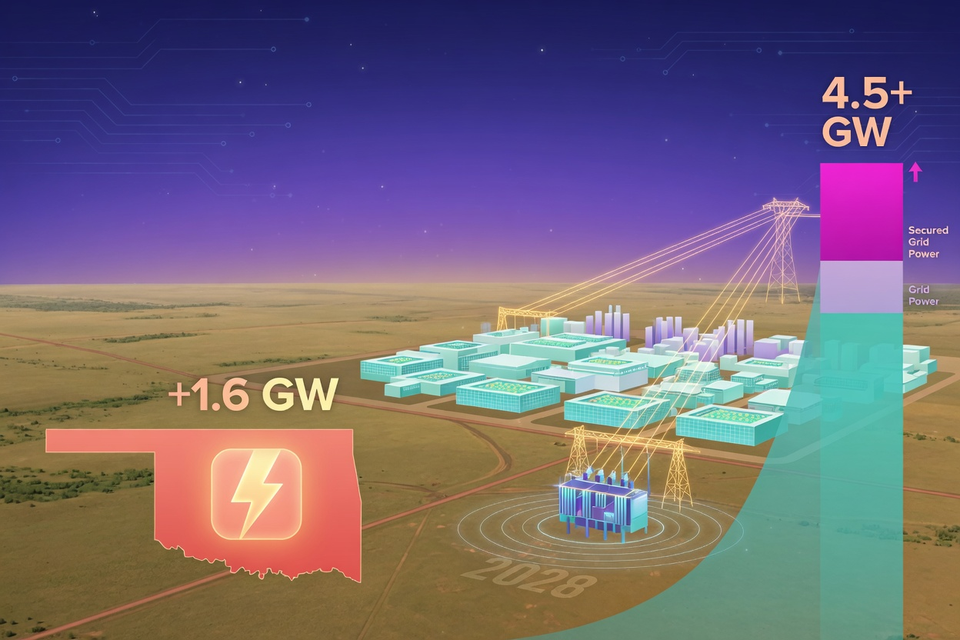
IREN has added a 1.6 gigawatt data center campus in Oklahoma to its development pipeline, lifting secured grid connected power above 4.5 gigawatts. The company puts the site at 2,000 acres, says grid studies are complete, and says power is scheduled to ramp from 2028.
Missing from the announcement is most of what a site selector would ask next. No city or county is named, no construction budget or phasing schedule is given, no anchor tenant is identified, and the location is described only as a large scale site with low latency network connectivity.
Financing on the compute side moved at the same time. IREN says it has secured $3.6bn of GPU financing tied to its Microsoft contract at an interest rate below 6 percent a year, which together with a $1.9bn Microsoft prepayment covers 95 percent of GPU related capital spending. A footnote in the same release records that the financing and its rate remain subject to agreed pricing parameters, base interest rates, execution of definitive long form documentation and customary conditions precedent.
Against that sits a revenue target the company says is not fully contracted. An expansion to about 140,000 GPUs is meant to deliver $3.4bn of annualised recurring revenue by the end of calendar 2026, built from an expected $1.94bn average annual revenue under the Microsoft contract plus an estimated $1.5bn from roughly 63,000 GPUs at British Columbia sites. IREN states that the estimate rests on internal assumptions about GPU models, utilisation and pricing, and that actual revenue may differ materially. The portion described as under contract at Prince George is about $0.4bn.
Revenue for the December quarter fell to $184.7m from $240.3m in the prior quarter, and the company posted a net loss of $155.4m against net income of $384.6m three months earlier. Adjusted EBITDA slipped to $75.3m from $91.7m. The swing is attributed mainly to non-cash and non-recurring items, including $219.2m of unrealised losses on prepaid forwards and capped calls tied to convertible notes together with a one-time debt conversion inducement expense, $31.8m of mining hardware impairments as British Columbia shifts from ASICs to GPUs, and $58.2m of stock based compensation.
Daniel Roberts, co-founder and co-chief executive, put the emphasis on the power position rather than the quarter. "With more than 4.5GW of secured power, we are able to advance a broad set of opportunities in our pipeline and support the next phase of growth," he said. Secured power is not energised power, and on the company's own schedule the Oklahoma ramp starts in 2028, so none of that capacity is available to anyone signing a contract this year.
Timing separates the two halves of the announcement. The GPU fleet and the Microsoft revenue attach to sites already under construction, with Horizon phases progressing and the British Columbia AI cloud expansion ongoing, while the Oklahoma campus is a land and interconnection position that pays off at the end of the decade. Cash and cash equivalents stood at $2.8bn on an unaudited preliminary basis at the end of January.
For buyers weighing where AI capacity will come from, the number that matters here is the 4.5 gigawatts of secured grid connection rather than the GPU count, because an interconnection queue is the constraint money cannot shorten. Engineers should read the 2028 ramp date as the real availability marker for the Oklahoma site, which puts it outside any procurement cycle being negotiated now.




Leave a Reply