
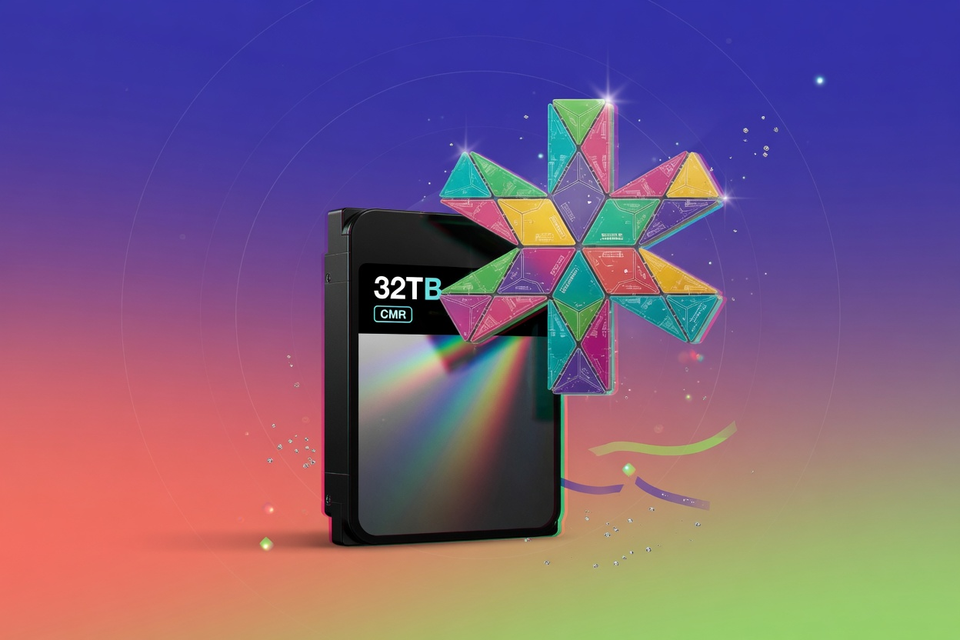
Seagate is shipping 32TB conventional magnetic recording drives to channel and retail partners across three product lines, with availability starting January 14 and recommended retail prices topping out at $849.99.
Pricing runs against the usual order. Cheapest of the three is the SkyHawk AI 32TB at a recommended $699.99, a drive built for AI-enabled network video recorders. The Exos 32TB, sold into cloud and enterprise data centres, is $729.99. Dearest is IronWolf Pro at $849.99, about $26.56 per terabyte against $21.87 for the surveillance part.
What is doing the recording is less clear. The press release builds the launch on "leadership in CMR technology" and says the drives follow a blueprint "where Seagate Mozaic technology at higher capacities is already proven" in cloud environments. A company blog post on the same launch, bylined by senior product marketing manager Michael Kulich, restores the word the release omits, describing "Seagate HAMR-enabled Mozaic technology at higher capacities is already proven".
Then the blog complicates it. Kulich calls the launch "a world-first 32 terabytes (TB) of proven conventional magnetic recording (CMR) technology" delivered across the three lines, and later writes that "The Exos 32TB with Mozaic® technology delivers unmatched areal density in a familiar 3.5-inch form factor". Mozaic is the HAMR platform by that same post's definition. A single Exos 32TB cannot be both, and neither document says which it is.
"This pivot demands a new kind of data backbone: mass-capacity storage at the edge and in the data center to keep insights flowing and archives searchable," said Melyssa Banda, SVP of Edge Storage and Solutions at Seagate. The argument underneath is retention. Once analytics index footage, an operator has a reason to keep it rather than overwrite it, and footage that is kept becomes a capacity purchase rather than a bandwidth one.
The supporting research needs a label the release declines to give. The press release states that "IDC reports that more than 75% of organizations expect their video data to at least double over the next five years". The blog credits the same finding to "a recent Seagate-commissioned IDC survey" and reports it as more than 75% of respondents rather than of organizations. From the same survey the blog pulls 66% of enterprise leaders expecting moderate or significant storage growth over two years, and 34.2% saying their storage infrastructure is fully optimised for GenAI.
Specification detail is thin for a capacity record. SkyHawk AI is rated for over 10,000 hours of video and analytics at three times the workload of standard video drives. IronWolf Pro gets a 550TB per year workload rating, a 2.5 million hour MTBF and AgileArray firmware for vibration tolerance in multi-bay enclosures. Exos gets one areal density figure, up to 3TB per platter, plus a claim of "90% proven components", which is a polite way of saying most of the bill of materials carries over from the platform before it.
Venue completes the picture. Intersec is a security trade show in Dubai rather than a storage or datacentre event, and the announcement is framed around video image analytics from the first line. Density is being sold here to the people who run camera fleets, and the datacentre part rides along.
Bootnote: Mozaic is the brand for the HAMR-based platform, and the company's own account places it in cloud environments at capacities above the ones announced here. Read that way, a 32TB CMR family is a statement about allocation rather than about physics. The recording technology that scales furthest goes to hyperscale buyers first, and anyone ordering through a channel partner gets the conventional platform stretched one more notch.



Leave a Reply