
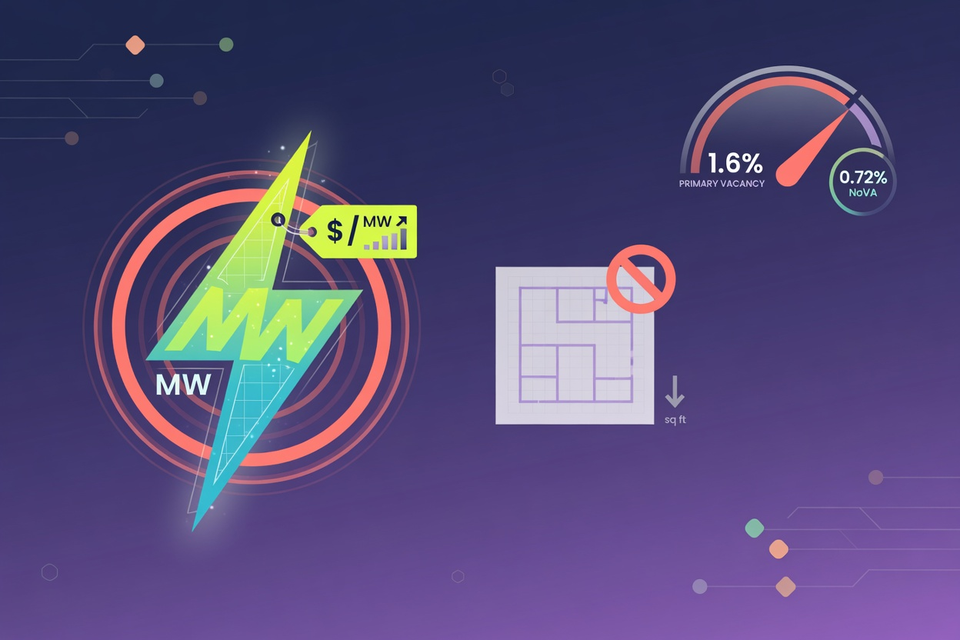
Buyers negotiating colocation contracts in 2026 are bidding for power delivery, not square footage. Primary-market vacancy fell to 1.6 percent in the first half of 2025, down from 2.8 percent a year earlier, according to CBRE North America Data Center Trends figures cited by Data Center Knowledge. Northern Virginia, the largest colocation market, sits at 0.72 percent vacancy.
The construction pipeline offers little near-term relief. CBRE counts 5,242 megawatts under development across North America, and nearly three-quarters of that capacity is already pre-leased, with commitments extending into 2027 and beyond. A buyer signing today is competing for what remains after hyperscale commitments are subtracted.
Pricing reflects the squeeze. Average rates reached $184 per kilowatt per month for deployments of 250 to 500 kilowatts in the first half of 2025, per the same CBRE data, and requirements of 10 megawatts or more saw increases of up to 19 percent. Density compounds the cost picture: legacy colocation racks ran at 5 to 7 kilowatts, while AI workloads now demand 50 to 100 kilowatts per rack, so the same footprint carries an order of magnitude more power and cooling load.
Site selection is following the electrons. "Energy resources, not immediate proximity to an urban core, are now the primary site-selection driver," Everett Thompson, CEO of Wired Real Estate Group, tells Data Center Knowledge. Thompson expects growth to keep shifting away from the top ten markets toward power-advantaged secondary and tertiary regions, citing utility constraints, permitting timelines, and widening energy price differentials. For a buyer, that means the cheapest megawatt may sit two states away from the nearest network hub, with the latency and staffing trade-offs that distance carries.
Contract structures are changing shape as well. "Colocation is adding a build-to-suit model, with hyperscalers and neoclouds leasing entire buildings, or even entire campuses," says Jenn Cahill, Associate Vice President at Black & Veatch. Whole-building leases remove capacity from the retail market before it is ever listed, which narrows the options for mid-sized deployments.
Equipment economics add a second layer of cost. "Equipment, replacement, and upgrade costs have skyrocketed due to tariffs and AI construction consuming all the equipment for new construction," says Peter Feldman, CEO of QTD Systems. Component supply is tightening too. "We expect memory and storage shortages, and the raised costs, to continue at least into Q3 [2026]," says Christina Qi, CEO of Databento.
Demand shows no sign of easing against that supply picture. MarketsandMarkets projects the global colocation market growing from $104.2 billion in 2025 to $204.4 billion by 2030, a 14.4 percent compound annual growth rate, though a projection at that distance depends on power buildout that has not yet been permitted.
Buyers planning 2026 and 2027 deployments should expect the first question from any provider to be megawatts required and delivery date, not racks. Locking capacity early, and pricing secondary markets against the latency they add, is now the difference between a signed contract and a waiting list.




Leave a Reply