
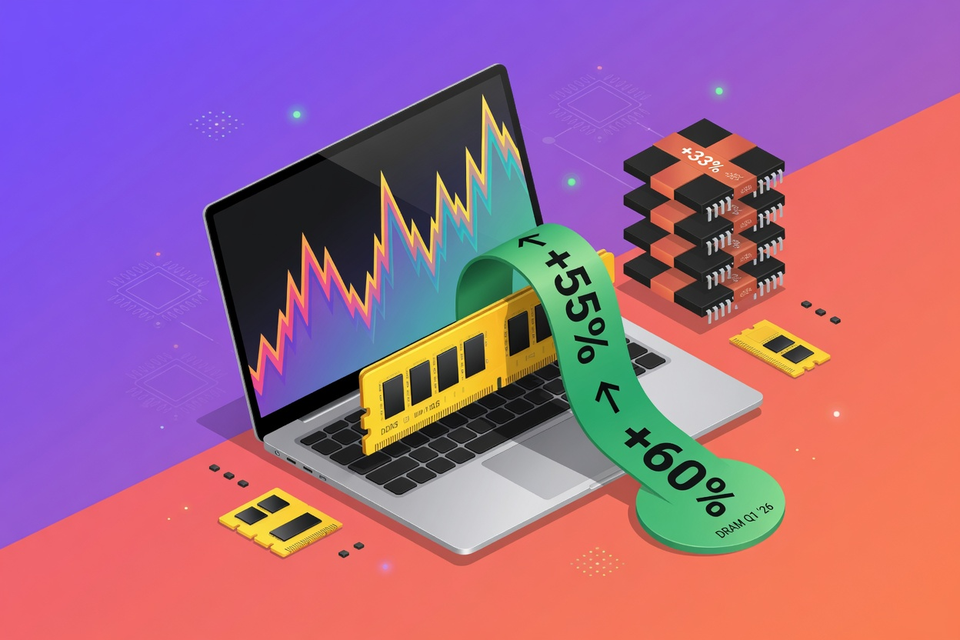
Here's a fact that will make sense of a lot of confusing price tags this year: Samsung, SK hynix, and Micron are about to have a very good quarter, and it's coming straight out of the pockets of anyone who wants more memory in a laptop or phone. Market watcher TrendForce expects ordinary DRAM contract prices, the wholesale rate memory makers negotiate with big buyers rather than the sticker price you see at checkout, to rise somewhere around 55 to 60 percent in the first quarter of 2026. NAND flash, the memory that stores your files rather than juggling active data, is forecast to climb 33 to 38 percent over the same stretch.
Server-grade DRAM is where it really gets ugly, with TrendForce projecting increases north of 60 percent as American cloud providers lock in supply and lean on manufacturers' shrinking inventories. That's not a one-quarter blip either. TrendForce's outlook has contract prices climbing steadily from the final quarter of last year straight through this one, led by the conventional DRAM that goes into everything from game consoles to office desktops.
Samsung is widely expected to post a sharp year-on-year jump in operating profit once these numbers land in its books, and SK hynix and Micron are leaning the same direction, both treating high bandwidth memory and server DRAM as their main profit engine for 2026. If that phrase HBM sounds familiar, it should: it's the stacked memory that sits right next to AI accelerator chips, and demand for it is a big part of why regular memory is getting squeezed.
Think of the global memory supply as a single, not-infinite bakery. Hyperscalers building AI servers have shown up with enough cash to buy the whole shelf of good bread every morning, and they keep coming back. Everyone else, meaning the people who just want a normal loaf for a normal laptop, gets whatever's left, at whatever price the bakery decides to charge for it.
That scarcity shows up in real product decisions, not just spreadsheets. PC makers who used to ship generous default memory configurations are more likely to trim them, stretch out refresh cycles, or turn what used to be a modest step, like bumping a laptop from 16 gigabytes of RAM to 32, into a genuinely expensive upgrade. Phone makers face a milder version of the same squeeze: even when seasonal demand for handsets cools off, tight supply of the mobile memory variant called LPDDR keeps prices firm, because the same factories are busy prioritizing server parts.
Enterprise solid-state drives are catching the same current. As data centers keep buying storage to feed AI workloads, that demand crowds out capacity that would otherwise go to the SSDs inside consumer PCs, which keeps NAND pricing elevated even for people who have never thought about a data center in their life.
None of this is really an accident of bad planning. After getting burned by boom-and-bust cycles before, memory makers have gotten disciplined about managing output and protecting margins rather than chasing every last unit of volume, which means prices can move faster than device makers, or shoppers, are comfortable with. The surge, in other words, isn't a weird glitch in the memory market. It's what happens when the AI industry decides it wants first pick at the bakery, indefinitely.



Leave a Reply