
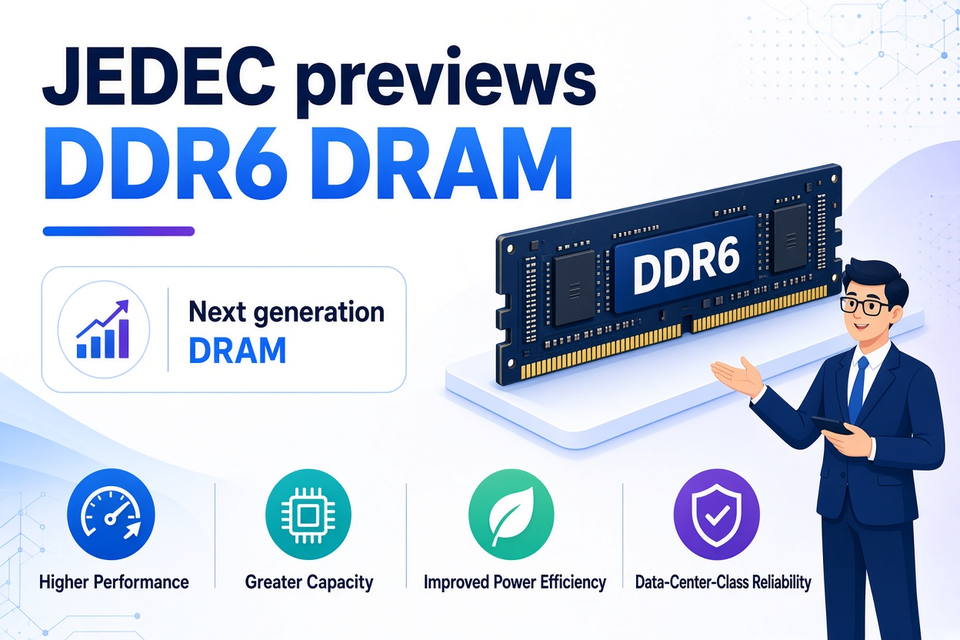
Server memory and commodity flash are moving in opposite directions. JEDEC has laid out a DDR6 design built on a data bus 50% wider than DDR5's, while TrendForce now projects NAND contract prices falling from the first quarter of 2027 as supply growth outpaces demand.
DDR6 takes shape on paper
For registered server modules, the DDR6 preview sets a starting data rate of 12.8 GT/s, up from DDR5's 9.2 GT/s, with a roadmap to 14.4 GT/s and beyond. The data bus grows from 64 to 96 DQ signals. JEDEC says the two changes combine to raise bandwidth by more than 50% at introduction, then adds a caveat: "This bandwidth target is distinct from a claim of equivalent improvement in application performance."
Capacity gains come from support for DRAM die densities up to 128Gb, die-stacking optimizations and a 74mm module length, against 133mm for DDR5. The planned architecture organizes memory access into pseudo-channels and doubles the bank count. On power, JEDEC ties a targeted performance-per-watt improvement over DDR5 to VSS-terminated I/O and data-center-focused low power modes, and gives no figure for the gain.
None of it is final. The standards body describes the features as "current JEDEC DDR6 development plans rather than a finalized standard," subject to change and to disapproval by its board. The release sets no date for publishing the standard or for DDR6 products. Converge Digest notes the preview does not say which DDR5 configuration serves as the bandwidth baseline, and does not address voltages, backward compatibility or the number of DIMMs per channel.
Flash pricing turns
Flash is heading the other way. TrendForce forecasts overall NAND contract prices will decline 0% to 5% quarter over quarter in the first quarter of 2027, with all product categories in a downward cycle from the second quarter. The firm also lowered its forecast for the fourth-quarter 2026 contract price increase to 8% to 13%.
Supply explains most of it. TrendForce estimates NAND industry capital spending will rise 26.7% year over year to $29.9 billion in 2027, with bit supply growing 25% to 30%. Demand is splitting by region. US cloud providers have raised their 2027 forecasts again, but Chinese cloud providers, facing GPU shortages, elevated inventories and competition over token pricing, cut enterprise SSD orders by more than the US increase.
Spot markets moved first. TrendForce News reports NAND spot prices down 20% in two weeks as Chinese traders trim inventories. The weakness is uneven: the same article carries a TrendForce forecast that enterprise SSD contract prices will rise 15% to 20% in the fourth quarter of 2026. Bank of America, cited by Seoul Economic Daily and relayed by TrendForce News, estimates smartphone and PC NAND contract prices could fall 5% to 10% in the first quarter of 2027 while enterprise-grade products hold steady or edge higher.
How deep the 2027 decline runs would depend, in TrendForce's view, on how fast Chinese cloud providers work down inventory, on any change to restrictions on overseas GPU procurement, and on whether device makers keep cutting storage specifications. US policy after the midterm election is another variable, because AI data center projects planned for 2028 remain in planning and permitting.




Leave a Reply