
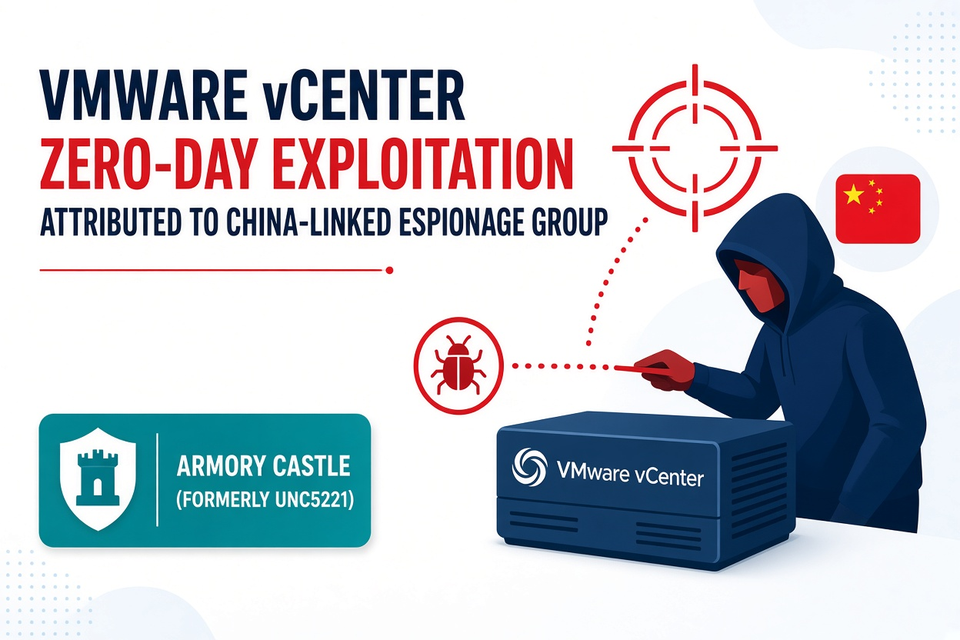
The management plane that sits above virtualized servers is where this week's main security disclosure landed. Broadcom released patches on November 19 for CVE-2026-123890, a critical authentication bypass in VMware vCenter Server, BleepingComputer reports. A suspected China-nexus espionage group had already been exploiting the flaw for more than two months, according to SecurityWeek, which puts its CVSS score at 9.8.
Operators use vCenter Server as the centralized appliance to configure, control and monitor ESXi hosts. Administrative access there gives an attacker control over the virtual machines the server manages, BleepingComputer notes. Mandiant and Google Threat Intelligence Group, whose researchers documented the attacks, describe the bug as an unauthenticated Secure Remote Password session key disclosure over DCE/RPC. "Successful exploitation results in a remote authentication bypass which creates an authenticated session established as administrator@vsphere.local," they write.
How the intrusion ran
Attribution comes from Mandiant, which names the group ARMORY CASTLE, formerly tracked as UNC5221, and cites forensic evidence. The attackers did not start at vCenter. They first exploited CVE-2026-102764, a zero-day in BeyondTrust Remote Support, then moved laterally to internal Linux appliances that lacked endpoint detection and response tooling. From there they scanned for VMware-specific ports, including port 2012, the control interface for vCenter Single Sign-On.
A Go-based utility Mandiant calls BONESAW then exploited the vCenter flaw to exfiltrate the Lightning Memory-Mapped Database, hijack the SAML Security Token Service and create a Single Sign-On administrator account. SecurityWeek reports that a second tool forged SAML tokens, and that the intruders took the vCenter master encryption key and database credentials before moving to an ESXi host. Mandiant counts two zero-days and three sets of tailored malware in the campaign, which it reads as evidence of "deep platform expertise and substantial resource backing."
What is fixed
Fixed builds are vCenter 9.1.1.0200, 9.0.2.0200 and 8.0 U3m, per SecurityWeek. The same report says BONESAW works against vCenter 7.x and 8.x, citing Mandiant, and that no public patch exists for version 7.0, which reached end of general support in October 2025. No official workaround is available, although network restrictions and firewall controls can reduce exposure, BleepingComputer reports, citing Broadcom. The flaw applies whether or not Enhanced Linked Mode is enabled.
Exploitation is documented by the researchers, not the vendor. Broadcom's advisory, VMSA-2026-0009, does not mention in-the-wild exploitation, SecurityWeek reports, and BleepingComputer says the company has not confirmed that the flaw was exploited. Mandiant reported the bug to Broadcom. Its CTO, Charles Carmakal, said on LinkedIn that the firm investigated multiple incidents involving the flaw, according to SecurityWeek, which also quotes him: "Organizations should both apply the patches and examine their systems for evidence of compromise."
Knowledge of the flaw predates the September exploitation. BONESAW was run against a vCenter server already patched for CVE-2026-59309, a separate authentication bypass disclosed in July, and SecurityWeek quotes Google's finding on the point: "Mandiant has evidence that Armory Castle had knowledge of CVE-2026-123890 prior to the disclosure of CVE-2026-59309 on July 29, 2026."




Leave a Reply