
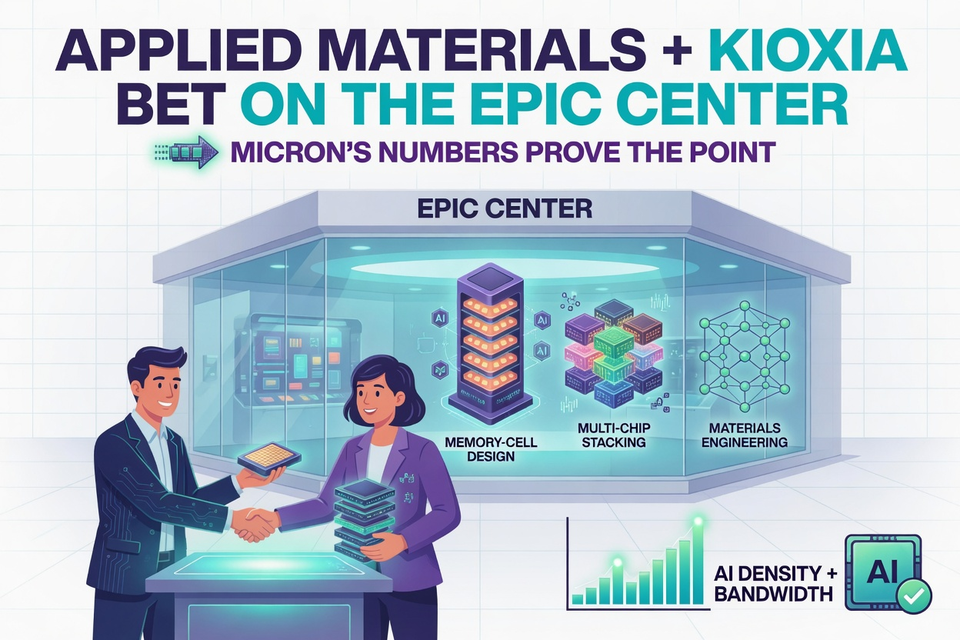
Applied Materials and KIOXIA are partnering inside Applied's EPIC Center in Silicon Valley to develop next-generation memory technology for AI workloads, the companies said in a joint release distributed via GlobeNewswire. The work covers advanced memory-cell and structure design, multi-chip stacking architectures, and materials-engineering approaches meant to raise density and performance for AI systems. "AI infrastructure requires memory solutions that can deliver dramatically higher density, greater bandwidth and improved energy efficiency," said Gary Dickerson, Applied Materials' president and chief executive.
Flash memory and SSD expertise, not DRAM, is what KIOXIA brings to the arrangement, a different slice of the memory stack than the one dominating recent earnings. Applied's EPIC Center, short for Equipment and Process Innovation and Commercialization, is billed as the largest-ever U.S. investment in advanced semiconductor equipment research and development and is meant to be operationally ready this year. Capital spending there is expected to scale to roughly $5 billion over time as customer projects come online, the release notes, rather than a sum already committed or spent. "Memory is at the center of the AI innovation roadmap, and the challenges of increasing memory density while managing cost and complexity require breakthroughs across materials, equipment and process technology," said Dr. Prabu Raja, who leads Applied's Semiconductor Products Group. KIOXIA's own chief executive, Hiroo Ota, called the pairing a chance to "stretch the boundaries of materials and process innovation."
The timing lands in the same stretch this desk covered Micron's own blowout quarter, when pricing and tightness in the memory market were the story inside the company's own numbers. Applied and KIOXIA's bet sits upstream of that print. It targets the equipment and packaging work that determines how much additional capacity the industry can bring online, not a single quarter's results, and its payoff, if there is one, shows up in fabs years from now rather than in a filing next quarter.
Other memory and equipment names used the same stretch to generate noise rather than news. SK hynix published a recap of its own conference appearance at TSMC's OIP event rather than disclosing anything new, and a cluster of syndicated previews and re-coverage circled the same Micron quarter this desk had already reported in full. Neither added a fact beyond what was already on the record. The EPIC Center partnership, by contrast, is the one item in the week's memory coverage that neither previews an old number nor restates one.
If the EPIC Center work moves from the lab bench to qualified production lines on the timeline the companies describe, it could ease the equipment side of a supply constraint that pricing increases alone have not solved. That remains conditional on execution neither company has demonstrated yet.


Leave a Reply