
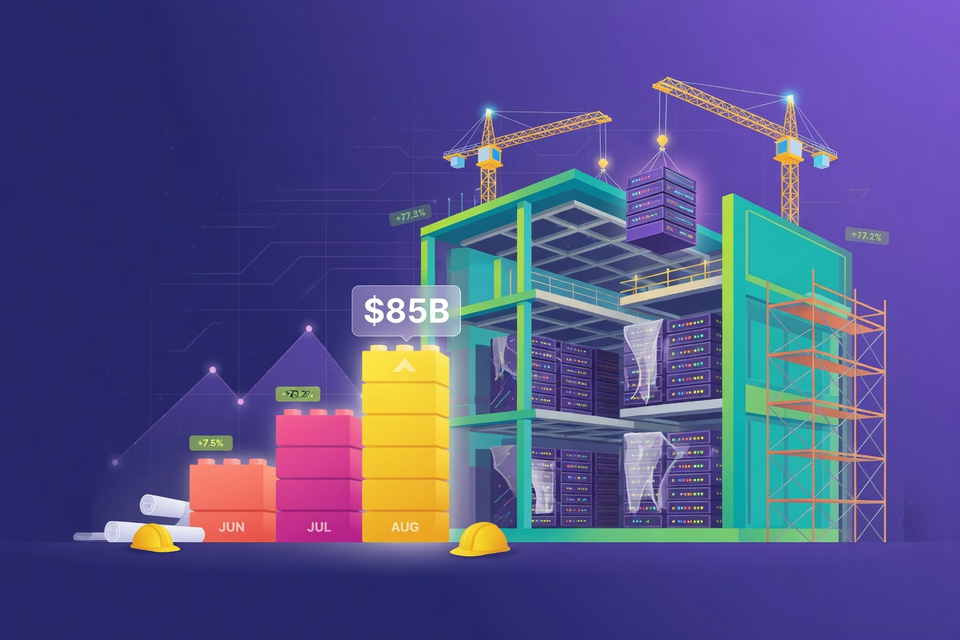
The U.S. Census Bureau's construction spending release for August puts data center work at a seasonally adjusted annual rate of $84.95 billion, 7.5 percent above July and 73.2 percent above August 2025. The same tables revise July to $79.0 billion from the $75.2 billion first reported a month ago, and June to $72.7 billion from $70.8 billion.
Revisions matter as much as the headline number. The preliminary data center figure has been raised in each of the last two months, by $1.9 billion for June and $3.8 billion for July, by my arithmetic on the bureau's tables, so the August estimate should be read as a first draft. The monthly series now runs $61.9 billion in April, $65.7 billion in May, $72.7 billion in June, $79.0 billion in July and $85.0 billion in August, five consecutive increases.
Data centers are filed by the bureau as a subcategory of office construction, and the parent line is now mostly data centers. Private office spending was $134.1 billion at an annual rate, up 4.6 percent on the month and 29.8 percent on the year; data centers account for about 63 cents of every office construction dollar. Strip them out and the rest of the office category comes to roughly $49.2 billion, against $54.2 billion a year earlier, a decline of about 9 percent by my calculation.
The wider market is flat. Total construction spending was $2,203.1 billion at an annual rate, 0.9 percent above July and 1.7 percent below a year earlier. Private nonresidential spending rose 1.0 percent on the month to $773.0 billion and sits 1.0 percent below August 2025. Data centers are now about 11 percent of that private nonresidential total, up from about 6 percent a year ago.
Two neighboring categories matter to anyone planning a facility. Private power construction, which the bureau defines to include gas and oil work, rose 0.9 percent to $165.9 billion and is 9.7 percent above a year earlier, while manufacturing construction was unchanged on the month at $168.2 billion and 19.8 percent below August 2025. Factory building is still nearly double data center building in dollar terms, even after a year in which one shrank by a fifth and the other grew by nearly three quarters.
The dollars cover less than the headline suggests. Wolf Street reports that the Census figures capture the building, the site work and the equipment integrated into the building, such as HVAC, and not the servers, racks, network gear or electrical equipment that make up the expensive part of a data center. The same report, citing producer price index data, puts construction materials prices up 10.1 percent year over year in August and nonresidential construction services up 9.4 percent, so a share of the 73 percent rise is price rather than square footage. The Census series is seasonally adjusted but not inflation adjusted.
What the series measures is the value of work put in place during the month, not contracts signed or capacity energized, so it lags the announcements and leads the ribbon cuttings.
For a buyer, the practical reading is that the pool of competing work has grown 73 percent in a year and is still being revised upward after the fact, while the materials and services going into it are inflating at close to 10 percent. A project bid against last year's prices is now bid against a market nearly three quarters larger and measurably more expensive per unit of building.


Leave a Reply