
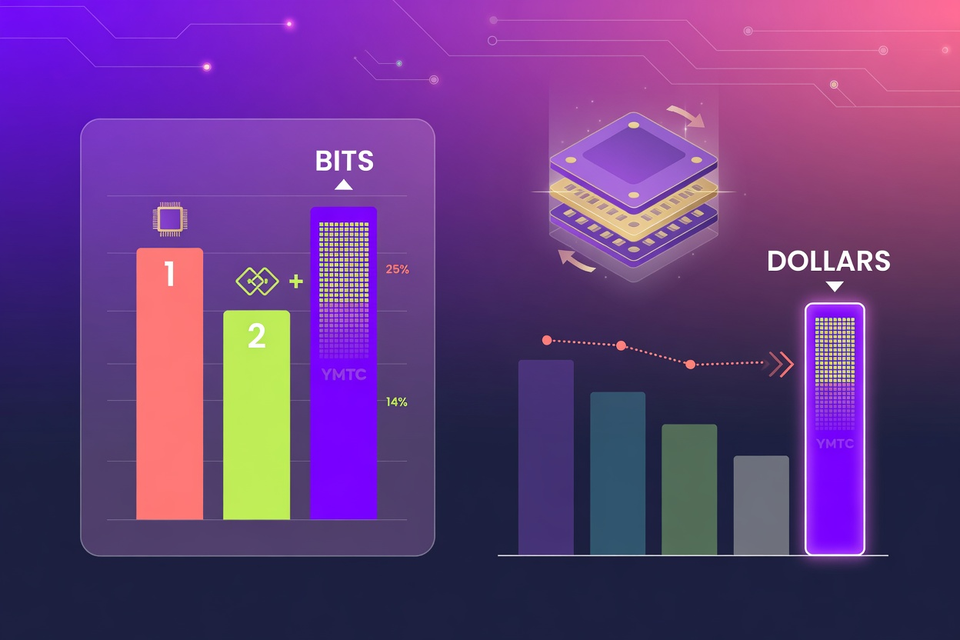
The correct level of alarm about YMTC depends entirely on which ranking you read. By shipments, Counterpoint Research puts China's NAND champion at 14 percent of the global market in the second quarter, level with Kioxia and behind only Samsung at 25 percent and the SK hynix-Solidigm pair at a combined 22 percent, as reported by The Korea Herald. By revenue, YMTC ranks fifth. The gap between third in bits and fifth in dollars is the whole story, and it is closing.
The catalyst is capital. YMTC filed on August 21 for a Shanghai IPO seeking about $4.9 billion, per the report, with 63 percent of proceeds earmarked for upgrading mass production lines and the remaining 37 percent for research and development including next generation NAND and enterprise storage. That split tells you the company believes its technology is closer to competitive than its capacity is.
Why the revenue gap exists is the part worth decoding. NAND bits are not priced equally: the same silicon earns dramatically more inside an enterprise SSD sold to a hyperscaler than inside a consumer device, and enterprise drives absorbed 48 percent of all NAND bits shipped in the second quarter, up from 26 percent a year earlier, per Counterpoint figures in the report. YMTC's bits have historically flowed to the cheap end. A Counterpoint director told the Herald the company plans to shift its mix toward enterprise SSDs in the second half of the year, and a Hana Securities analyst made the underlying point plainly: with enterprise SSD prices this elevated, identical bits earn wildly different revenue depending on where they land.
For Samsung and SK hynix, the near term threat is not YMTC taking hyperscaler sockets, where qualification cycles and a US entity-list history still stand in the way. The sharper risk runs through the commodity end: every YMTC bit that ships into phones and consumer drives is a bit the incumbents no longer sell there, which frees Korean capacity for enterprise but also concentrates everyone's growth hopes on the same premium tier. And the report flags the longer arc: capacity added during a shortage does not vanish when the shortage ends, and IPO-funded fab lines will still be producing when today's frantic pricing has normalized.
Context makes the timing pointed. This desk noted Monday that weekend policy reports had markets pricing a possible opening for Chinese memory into Apple's supply chain; a $4.9 billion war chest for the NAND supplier at the center of those scenarios does not settle that question, but it funds every version of it.
Bootnote: YMTC reached 14 percent of global shipments roughly a decade after shipping its first 3D NAND, on an architecture, Xtacking, that bonds the logic wafer to the memory array, which Western analysts spent years describing as a cost dead end. The lesson about dismissing second tier suppliers on architectural grounds has now been taught by enough companies that it should stop needing teaching.




Leave a Reply