
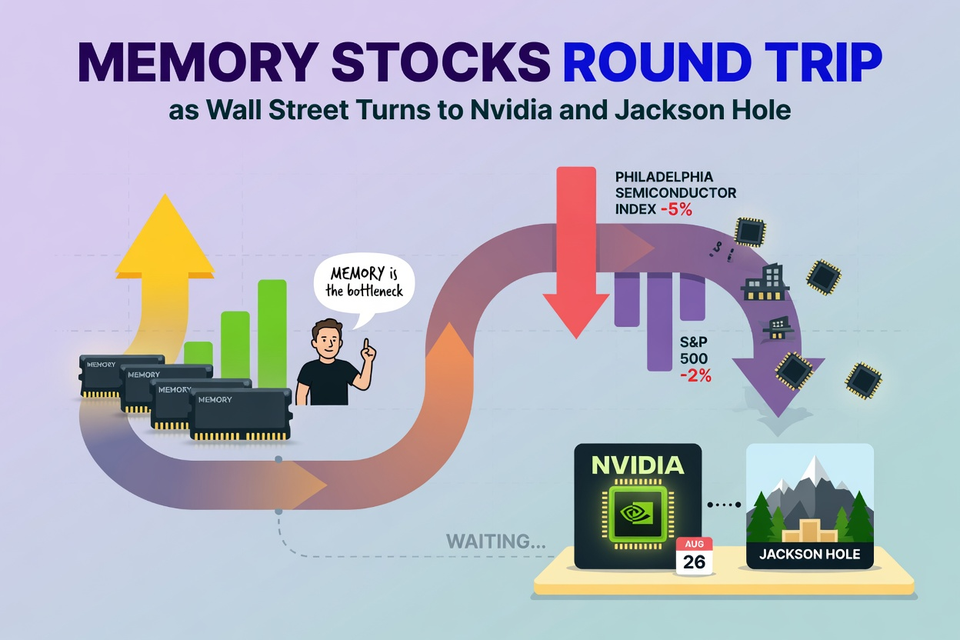
The AI trade spent the week arguing with itself. Memory stocks opened with a surge after Elon Musk described memory, not processors, as the part holding back AI expansion, then gave most of it back within a day. The Philadelphia semiconductor index finished down roughly 5 percent, and the S&P 500 slipped to about 2 percent below its record high. The whole complex now waits on two events: Nvidia results on August 26 and the Federal Reserve's Jackson Hole symposium beginning the day after.
Monday belonged to the bulls. SanDisk rallied 8 percent, Western Digital rose 6 percent and Micron added 5 percent after Musk's comments put a spotlight on memory supply as the binding constraint in AI buildouts.
Tuesday took it back. Rising Treasury yields compressed valuations across the sector in the morning, with Micron down 5 percent, SanDisk off 6 percent and Western Digital 7 percent lower in early trading. A Wall Street Journal analysis, as reported by 24/7 Wall St., then gave the selling a second driver: nine large technology companies carry roughly 3 trillion dollars in off-balance-sheet commitments, most of them tied to AI infrastructure, about triple what they owe on leases and long-term borrowings and well ahead of annual capital spending near 600 billion dollars. By the close, one account had SanDisk down 9.1 percent, Micron down 7.3 percent and Western Digital down 5.3 percent.
The selling met a sector that had gone nearly vertical. SanDisk entered Tuesday up 44 percent for the week and 653 percent for the year. Micron carried a 255 percent annual gain, Western Digital 211 percent. No memory-specific bad news surfaced on the day, and Micron chief executive Sanjay Mehrotra's standing description of the market still applied: "DRAM and NAND industry demand continues to significantly exceed industry supply."
Rates did the quiet damage underneath. The 30-year Treasury yield touched its highest level since 2007, raising the discount rate on the market's most extended trade and the financing cost on every fabrication plant behind it. Traders assigned a 35 percent probability to a Federal Reserve move in September and 66 percent by December.
What happens next will decide whether the week reads as a stumble or a turn. Nvidia reports second-quarter results on August 26, and consensus expectations call for earnings and revenue each roughly to double year over year, a bar that would leave little room for a soft outlook. "The market is so reliant on the AI trade today, and Nvidia is obviously the big boy in the room," said Erik Kratz, chief investment officer at Arena Private Wealth.
Then comes the Fed. Kevin Warsh takes the Jackson Hole podium for the first time as chair, at a symposium running August 27 to 29, with markets still mapping his approach to policy. "Everyone's way afraid that the Fed's reputation is now tarnished because of Warsh," said David Wagner, head of equities at Aptus Capital Advisors. Friday offered a reminder that nerves and buying can coexist. The Dow added 517 points heading into the earnings week.




Leave a Reply