
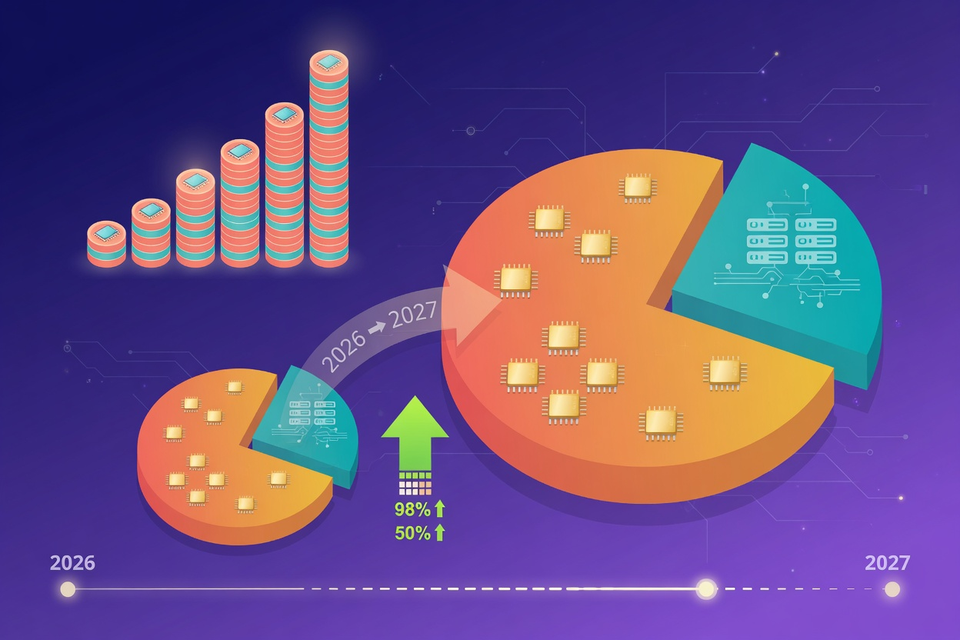
TrendForce has published the number that should reorder every AI infrastructure budget conversation: by 2027, DRAM and NAND flash together will account for 68 percent of major cloud service providers' total capital expenditure, up from an estimated 47 percent in 2026. The research firm's latest memory industry note, published on TrendForce's own press center, projects total CSP capex surging 98 percent year over year in 2026 and another 50 percent in 2027, with memory eating the growing pie faster than the pie grows.
The price trajectory behind that share is the aggressive part of the model. TrendForce's figures have server DRAM contract prices up a cumulative 64 percent in the second half of 2025 with a further jump of approximately 270 percent expected in 2026, while enterprise SSD prices rose around 35 percent in late 2025 and are projected to surge a cumulative 235 percent this year. HBM contract prices could still rise 70 to 140 percent in 2027 even with the price ceilings that some long-term agreements signed from the second quarter of 2026 onward have included.
Decode the supply side and the squeeze sharpens. TrendForce estimates HBM and RDIMM combined will absorb 51 percent of DRAM bit supply in 2026, meaning server applications now claim most of the world's DRAM bits before phones, PCs and everything else get a turn. Relief is penciled in for late 2027, when process migrations and new fab ramps are expected to lift combined server DRAM and HBM bit supply by 27 percent.
The two implications TrendForce draws deserve their own scrutiny. First, the firm argues elevated memory costs hand chip suppliers such as NVIDIA justification for raising their own prices, which converts a memory shortage into a general AI hardware inflation. Second, CSPs may need to raise capex further just to hold their chip procurement targets, which is the circular logic of this cycle in one sentence: spending more because spending more made everything cost more.
A word on what these numbers are. TrendForce's contract price data is the industry's standard reference, but the 2027 projections stack a price forecast on a demand forecast on a capex forecast, and each layer compounds the uncertainty of the one beneath. A 270 percent annual price jump is not a number with much precedent in server DRAM, and forecasts of that magnitude have historically marked the late innings of shortage cycles as often as the middle.
Bootnote: in the 2017-18 memory boom, DRAM and NAND briefly became the largest single cost in a server bill of materials and the industry declared a new normal shortly before prices halved. Memory taking 68 percent of hyperscale capex would be genuinely without precedent, which is either the strongest version of the AI buildout thesis or the clearest warning in it, depending on which chart you have been burned by before.




Leave a Reply