
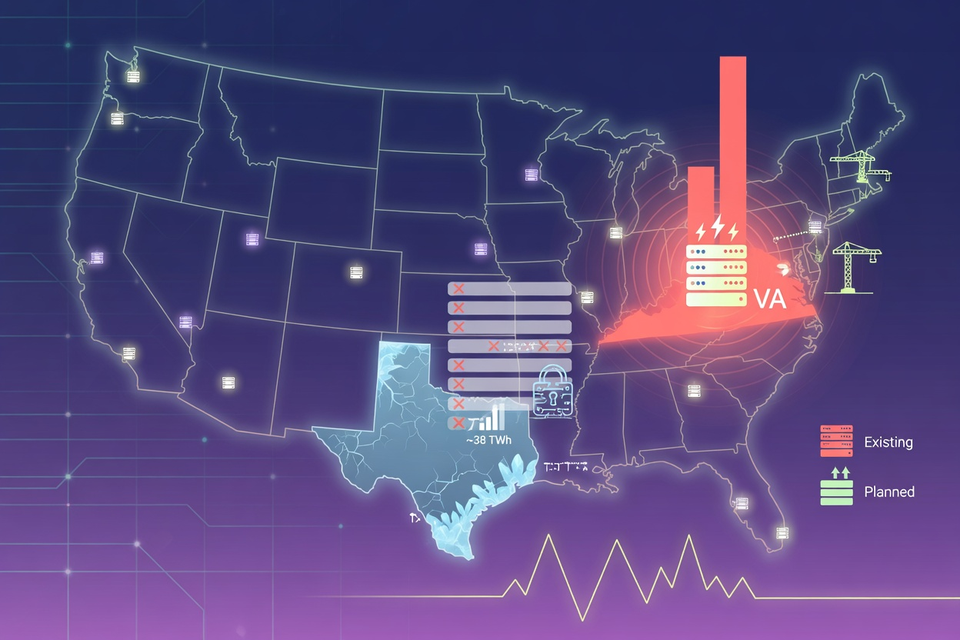
The United States runs more than 1,600 data centers that together draw roughly 176 terawatt hours a year, about 4.4 percent of all electricity consumed nationwide, according to a state-by-state tracker from ElectricChoice. The same tally counts another 480 facilities planned or under construction across more than 40 states, with total consumption projected to double by 2028 as AI workloads come online.
Lawrence Berkeley National Laboratory, cited in the tracker, puts the longer arc plainly: data center electricity use has tripled over the past decade.
Virginia remains the center of gravity. Data centers there consume more than one in four kilowatt hours generated in the state, and Dominion Energy attributed 21 percent of its sales to the sector as far back as late 2022. Dominion has since created a dedicated rate class, GS-5, for any facility drawing more than 25 megawatts.
Texas follows at roughly 18 terawatt hours a year. The gap between the two leaders and everyone else is wide, which is why connection terms in a handful of states set the tone for the whole market.
The load itself is changing shape as well: a conventional enterprise data center requests 5 to 10 megawatts from its utility. The AI-focused builds now entering queues request 50 to 300 megawatts each, a density the tracker puts at three to five times traditional facilities. Utilities did not design their interconnection processes for single customers the size of small cities.
ERCOT's queue illustrates the strain. The Texas grid operator reports roughly 474 gigawatts of interconnection requests, about 90 percent of them data centers, and Governor Greg Abbott has paused approvals pending state audits. "Any data center project that fails to comply with the verification and audit process to protect the reliability and resilience of the Texas electric grid must be denied," Abbott said. Utility Dive reports ERCOT planned to seek a good cause exemption to its planning timeline at the Public Utility Commission of Texas open meeting on August 20, after delaying the Batch Zero transmission study that covers the first projects in its new large-load process.
Restrictions are spreading below the state level too. A moratorium tracker maintained at datacenterbans.com counts 18 active bans or pauses, with 25 states restricting or weighing restrictions. Nye County, Nevada banned data centers in the Pahrump Valley on August 19, more than 30 North Carolina jurisdictions have acted during 2026, and New York halted new approvals in July for up to a year.
For a buyer placing capacity, the operative questions have shifted from land and fiber to rate class, queue position, and audit exposure. A megawatt in Virginia now carries GS-5 terms. The same megawatt in Texas carries an audit, and in a growing list of counties it is simply unavailable.
Power availability, not real estate, is now the binding constraint on where US data center capacity gets built. Buyers comparing sites should price the interconnection terms as carefully as the lease.




Leave a Reply