
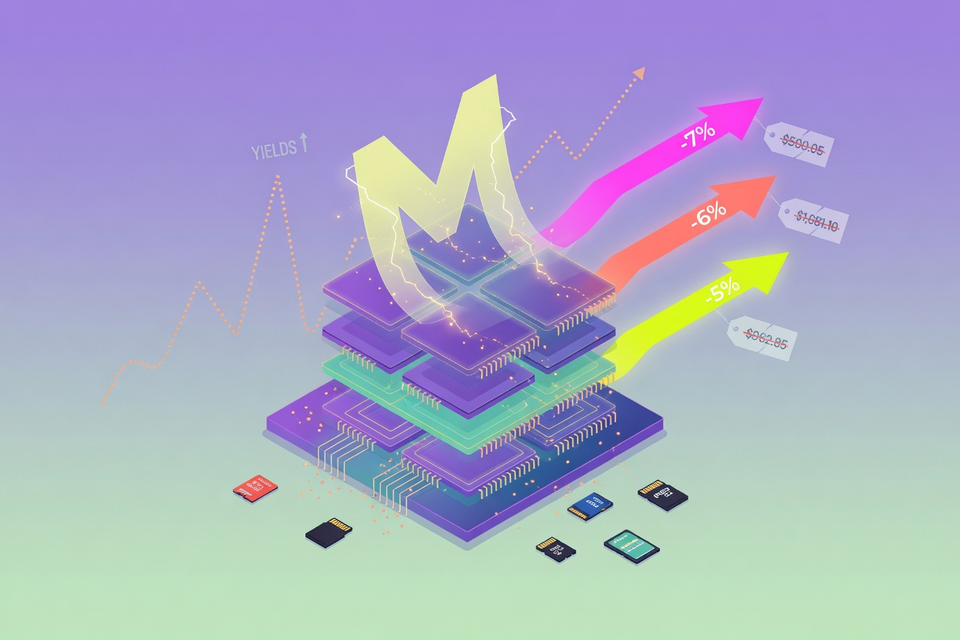
The memory complex gave back its Musk premium with interest: Western Digital fell 7 percent to $500.05, SanDisk lost 6 percent to $1,681.10, and Micron slid 5 percent to $962.85 in Tuesday morning trading, by 24/7 Wall St.'s count.
Selling was uniform across the complex. The same report has Seagate down 6 percent to $931, SK Hynix off 6 percent at $161.42, and the Roundhill Memory ETF down 6 percent to $56.88. When six tickers move within two points of one another, the news is not in anyone's order book. It is in the discount rate.
Rising Treasury yields are the cause on offer, and the mechanism cuts memory twice. Higher yields shrink the present value of earnings that arrive years out, and they raise the cost of financing fabrication capacity ordered on the same horizon. No sector borrows earlier against future bits than memory.
Nothing else in the tape was stressed. The VIX sat at 14.25 and the S&P 500 was off half a percent, which makes a 5 to 7 percent decline across an entire sector the loudest move of a quiet morning.
A session earlier the same names had rallied 5 to 8 percent after Elon Musk flagged memory as the bottleneck on AI buildout. Western Digital closed that session at $539.82. At $500.05 it now trades below where the week began, meaning the give-back exceeded the gain. Premiums built on a post unwind faster than premiums built on estimates.
On the year, the drawdown barely registers. 24/7 Wall St. puts 2026 gains at 255 percent for Micron, 653 percent for SanDisk, 211 percent for Western Digital, and 262 percent for Seagate. Gains of that size draw fast money, and fast money treats a yield move as an exit cue rather than a valuation debate.
What the coverage does not contain is any sign of the trade's fundamentals cracking. No DRAM or NAND contract-price data accompanied the selloff, and no vendor guided lower. Until bit pricing softens, this reads as a financing-cost correction inside an intact demand cycle, though a sustained climb in yields would test how much of this year's repricing was cycle and how much was liquidity.
Bootnote: memory's rate sensitivity is structural. A leading-edge DRAM fab is a multibillion-dollar commitment financed years before the first wafer sells, so the sector has always traded on the cost of money nearly as much as on the price of bits.




Leave a Reply