
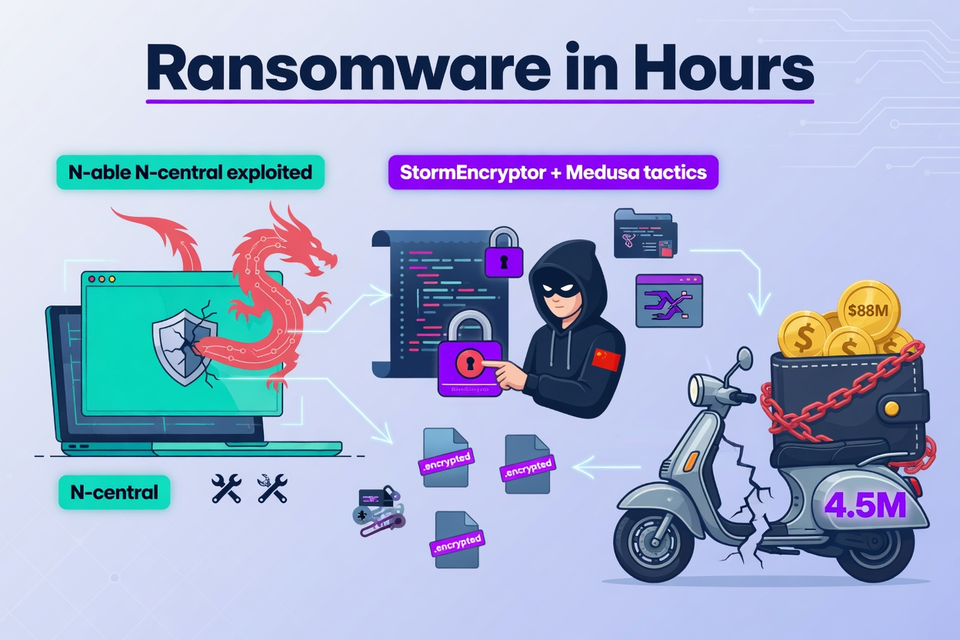
The week's defining incident turned a tool for managing computers into a weapon against them. Microsoft Threat Intelligence warns that Storm-1175, a China-linked and financially motivated group, is exploiting a critical flaw in N-able's N-central console, the remote monitoring platform that thousands of managed service providers use to administer client machines, and is using that access to deploy a new ransomware strain called StormEncryptor. The malware is written in C++, appends a.encrypted extension to the files it locks, and leans on the same tradecraft the group honed running Medusa ransomware, from Mimikatz credential dumping to quiet persistence through legitimate remote-access software.
The timeline explains the concern. A zero-day attack was detected on July 31. StormEncryptor deployments began on August 2, the same day an initial patch shipped, and an emergency hotfix followed on August 6. Microsoft describes "high-velocity ransomware campaigns" that exploited flaws "in some cases a full week before public vulnerability disclosure." Security firm Huntress calls what the bug grants an attacker "unauthenticated, 'god-mode' access."
Exposure remains wide. Roughly 28.6 percent of self-hosted N-central instances were still unpatched at the time of the warning, along with more than half of reachable cloud servers among one vendor's partner base. Storm-1175 previously hit healthcare, professional services and finance organizations in Australia, Britain and the United States, and the 2021 Kaseya compromise showed how a single management console can reach roughly 1,500 downstream businesses. A comparable blast radius remains possible if patching continues to lag.
The breach ledger filled out elsewhere. Ryde, an electric scooter operator active in Norway, Sweden, Finland and Germany, lost data on 4.5 million customer accounts, including phone numbers, email addresses, birth dates and partial payment card numbers. Coinkite, the Canadian hardware wallet maker, saw attackers exploit a firmware vulnerability and drain about 1,367 bitcoin, worth approximately 88.6 million dollars, from thousands of customer wallets. The company halted affected shipments while it investigates. Beacon, a British CRM provider serving about 1,500 nonprofit organizations, disclosed that attackers used a stolen access key to reach donation records and stored attachments.
Software supply chains took their own hit. A campaign dubbed Shai-Hulud CHAINDROP backdoored more than 400 npm packages after compromising the maintainer of the Keyv library, planting code that steals developer tokens and republishes poisoned packages across an ecosystem measured at about 1.3 billion monthly downloads. A separate group tracked as UNC6671 has been impersonating coworkers and IT staff at large United States financial firms, harvesting passwords and MFA codes and demanding between 750,000 and 3 million dollars. Physical infrastructure was not spared either: North Carolina's port authority moved operations at Wilmington and Morehead City to manual processes after a cyberattack, working through service delays while systems were restored.
The common thread runs through management and distribution layers rather than endpoints. An RMM console, a package registry and a firmware update channel each concentrate trust, and each proved this week that the concentration cuts both ways. For operators the immediate work is concrete: patch N-central before anything else, and audit systems for the AnyDesk, SimpleHelp and Advanced IP Scanner installations the attackers leave behind as their calling cards.




Leave a Reply