
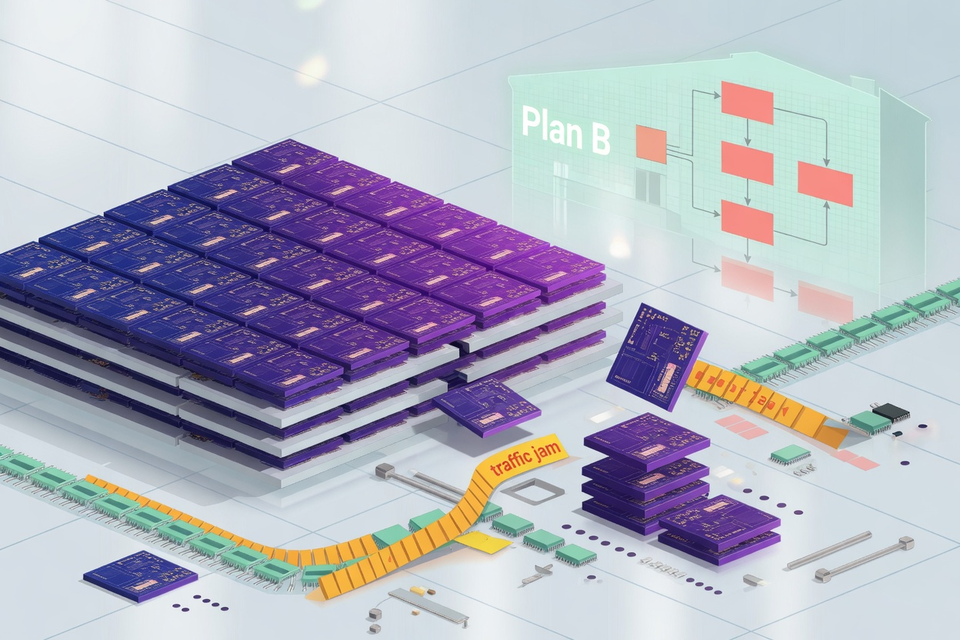
TSMC is sitting on a pile of the most advanced phone processors ever built, and it cannot ship them. Independent technology journalist Tim Culpan reported in his newsletter that roughly one billion US dollars' worth of Apple's A20 Pro chips, about NT$32 billion, are parked at the foundry as work in progress because the memory they must be packaged with is in short supply.
Work in progress, WIP if you want to sound like an operations person at parties, means the hard part is finished and the easy part is stuck. The A20 Pro is built on TSMC's 2 nanometre process and uses a packaging approach called Wafer-Level Multi-Chip Module, which bonds the processor to its LPDDR5X memory before the part ever leaves the supply chain. Picture a sandwich shop that cannot sell a single sandwich until the bread truck arrives. The processor is the filling, done and plated. The memory is the bread, and per Culpan's reporting, Micron is the main baker, with SK Hynix and Samsung behind it.
The bread truck is late for a familiar reason. Memory makers are steering their capacity toward AI datacentre contracts that pay better than phone parts, and MacRumors reports that Apple is scaling back its 2026 hardware shipment plans as a result, with the Mac Studio, Mac mini, MacBook Air and the iPhone 18 Pro line all named. Apple already raised Mac and iPad prices in June, and MacRumors says iPhone prices are expected to rise in September.
Not everyone buys the dramatic version of the stranded-chip story. Analyst Ming-Chi Kuo wrote: "In other words, tight memory supply is real. But my understanding is that there has been no dramatic scenario in which TSMC first built up US$1 billion of WIP and then had to wait for memory to arrive before packaging could proceed." Real shortage, he argues, tidier warehouse.
So what does a foundry do with idling leading-edge capacity? Wccftech reports, citing Liu Pei-chen of the Taiwan Institute of Economic Research, that TSMC can reroute those production lines toward AI and high-performance computing chips, which are less exposed to the phone-memory squeeze. The customers hoarding all the memory would, in effect, absorb the capacity the shortage freed up. There is a certain karmic tidiness to that, and I say this as someone whose home lab GPU budget has personally funded a measurable fraction of it.
The rerouting math is less exotic than it sounds. High-performance computing already produced 66 percent of TSMC's revenue in the second quarter, up 20 percent from the prior quarter within a record 40.2 billion dollar period, while smartphone silicon contributed 22 percent, according to BigGo's earnings coverage. The foundry that once lived and died by the September iPhone cycle now runs mostly on datacentre demand, and a stranded batch of phone chips, however expensive, is a rounding error against that mix.
Whether the bread truck arrives before iPhone 18 preorders open is the question that matters for anyone planning an upgrade. Kuo expects thin launch supply either way, so the memory drought may end up decided at the checkout page rather than in the fab.



Leave a Reply