
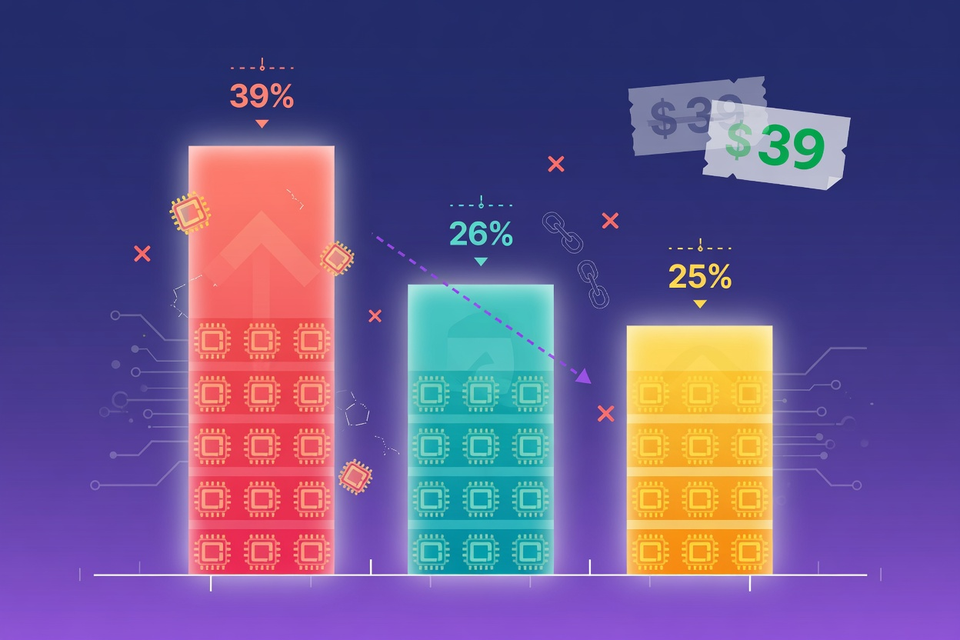
The DRAM repricing is redrawing the revenue table: Counterpoint Research puts Samsung at 39 percent of second-quarter DRAM revenue, back to its 2024 levels, with SK Hynix down to 26 percent from 39 a year earlier and Micron one point behind at 25.
Sit with the strangest number first. SK Hynix grew quarterly revenue 214 percent year over year and still surrendered 13 points of share. Growth like that only reads as decline in a repricing cycle, when the question is not who is selling more memory but who is capturing the new price. DigiTimes reads the table the same way: Samsung and Micron are benefiting more from rising conventional DRAM and NAND prices, while SK Hynix's concentration on high-bandwidth memory has slowed its conventional DRAM business even as it keeps the HBM lead.
MS Hwang, research director at Counterpoint, supplies the mechanism. "SK hynix was earlier to sign long-term agreements than competitors. Fixed prices negotiated early would be lower than current levels." Translated: SK Hynix sold certainty when the market was soft, and that contract vintage now clears below street. The share loss is a price-capture problem, not customer flight, and it will persist for exactly as long as those agreements run.
The quarter also produced an inversion worth naming. Conventional DRAM prices surged quarter over quarter while HBM prices fell year over year, dragged by HBM3E price drops and delayed HBM4 launches, per Counterpoint. The premium product deflated while the commodity inflated. A fab mix weighted toward HBM, which looked like the smart trade through the AI buildout, was the wrong place to stand for this particular quarter.
Samsung's side of the table is simpler. "Samsung overcame all its hurdles and delivered an exemplary turnaround in performance from the year-ago period," says Counterpoint senior analyst Jeongku Choi. The turnaround is conventional price leverage plus a stronger HBM presence, and it required no heroics beyond having general-purpose capacity online when general-purpose pricing took off.
Micron is the line to watch. "Micron's DRAM revenue has increased fivefold since Q2 2025, positioning the company to surpass SK hynix soon," says Neil Shah, Counterpoint's VP of research. An analyst's "soon" is not a date, but one point of separation sits within a single contract-renegotiation cycle. Counterpoint expects further conventional DRAM price increases in the third quarter and an HBM price rebound as next-generation parts ship in the second half; if both hold, the same table could tilt again, this time back toward the HBM-heavy mix.
Bootnote: the table's tail is moving faster than its head. CXMT grew revenue 716 percent year over year to reach 7 percent share, and Nanya grew 690 percent, per the same Counterpoint data. When the commodity end of a memory cycle inflates, the marginal producers inflate fastest, and the fifth line of the share table is usually where the next price war starts.




Leave a Reply