
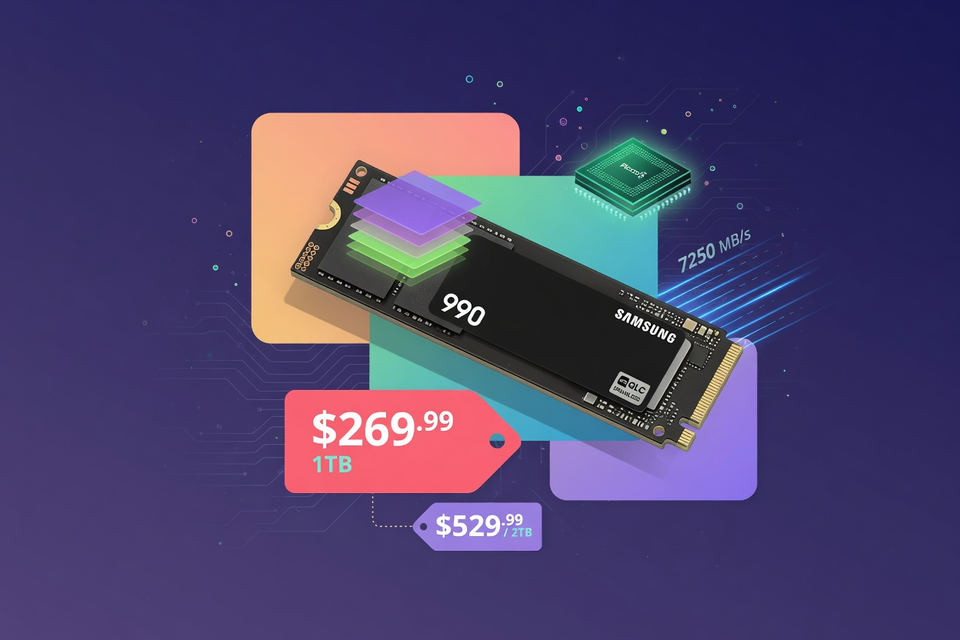
Samsung has started selling the 990, a DRAMless QLC drive that sets the value end of its SSD line at $269.99 for one terabyte and $529.99 for two. The naming is the news in miniature: no EVO, no PRO, just a plain number sitting below both, built from the company's newest QLC V-NAND and a 5-nanometer Piccolo controller on a PCIe Gen4 interface rated at up to 7,250 MB/s reads.
The spec sheet reads like cost engineering, and openly so. There is no onboard DRAM; the drive borrows host memory over the bus instead. The flash is quad-level. Even the controller tells the story: HotHardware reports the Piccolo silicon is PCIe Gen5-native, deliberately run at Gen4 speeds where the value market lives.
StorageReview's Lyle Smith calls the result "a mainstream Gen4 SSD built around efficiency and value, not benchmark supremacy." That is the polite version. In his testing the 2TB model turned in 7,177 MB/s sequential reads and 872,000 random read IOPS, respectable numbers that still trail DRAM-equipped rivals where latency matters, and HotHardware's benchmarks place it mid-pack among Gen4 drives, ahead of the original 990 EVO and behind the 990 Pro.
Efficiency is the genuine bright spot. HotHardware measured roughly 3 milliwatts at idle in its deepest power state and about 4 watts active, and reviewer Marco Chiappetta judges it a "good candidate for small form factor systems." The TurboWrite cache absorbs around 1.2 terabytes of continuous writes before QLC-native speeds take over, which covers most desktop workloads and none of the heavy ones.
Then there is the sticker. At $529.99, the 2TB drive works out to roughly 26 cents per gigabyte for QLC flash without a DRAM buffer, territory that premium TLC drives occupied not long ago. Smith writes that "the 990's value case will ultimately be set by street prices," which decodes to a plain fact about the market: this MSRP was set amid surging NAND contract prices, and Samsung is repricing the value tier rather than mispricing one drive. Endurance lands at 400 terabytes written per terabyte of capacity with a three-year warranty, the usual QLC trade stated without apology.
A value drive that costs this much is evidence of where flash economics sit, not a bargain. The 990 is a competent, efficient, deliberately modest product whose price tag carries the real headline.
Bootnote: the Host Memory Buffer approach the 990 leans on began life as a budget workaround in the NVMe 1.2 specification, letting DRAMless drives map their lookup tables into a borrowed slice of system RAM. A decade on, the workaround has become the default architecture for an entire market tier, and the 990 shipping a Gen5-native controller capped at Gen4 shows how completely the segmentation is now done in firmware and pricing rather than silicon.




Leave a Reply