
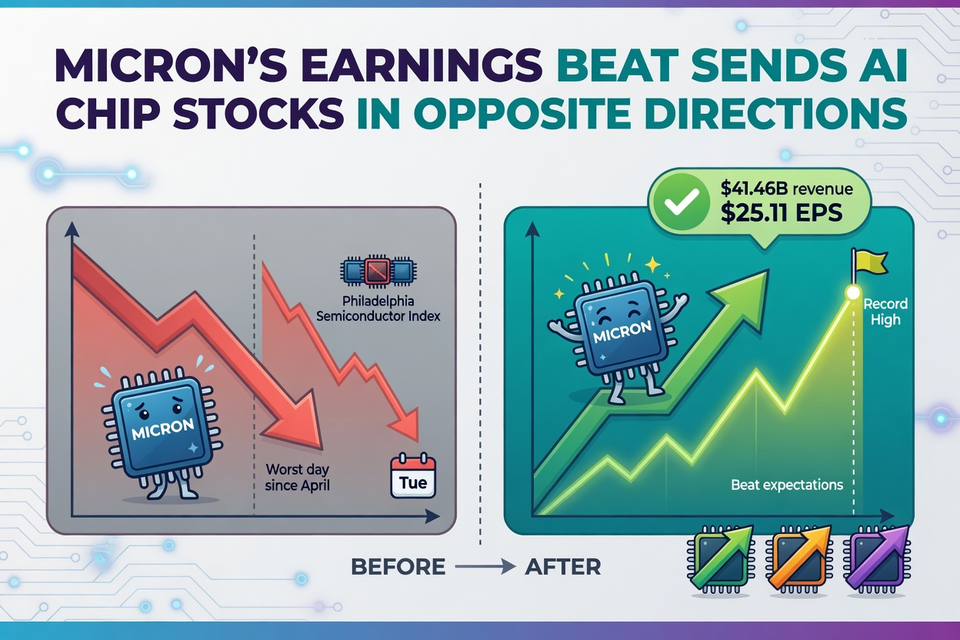
Micron's fiscal third-quarter results turned a rough week for chip stocks into a rally. The Philadelphia Semiconductor Index had its second-worst day in a year on the Tuesday before the report, and Micron itself had its worst single day since the "Liberation Day" sell-off of April 2025. Wednesday's earnings reversed that: revenue of US$41.46 billion and adjusted earnings of US$25.11 a share cleared Wall Street's expectations by a wide margin, and the stock surged as much as 19% intraday on Thursday to a fresh record high before paring some of the gain.
Gross margin reached a record 84.9%, more than double a year earlier, and management guided for roughly 86% in the current quarter. Micron said AI customers are increasingly treating memory as a bottleneck rather than a commodity: the company has signed 16 strategic customer agreements carrying take-or-pay commitments, 14 of which represent about US$100 billion of minimum contracted revenue over their remaining terms, backed by US$22 billion in cash deposits.
Sanjay Mehrotra, Micron's chief executive, said in the company's earnings release that the record fiscal third-quarter results and the stronger outlook for the fourth quarter reflected the strategic value of memory in the AI era.
By contrast, Nvidia's shares slipped about 1.6% the same day, even as Micron said its high-bandwidth memory supply for 2026 is already sold out under multi-year, fixed-price agreements and that it can currently fill only half to two-thirds of what several key customers want. Micron's HBM ships alongside Nvidia's Blackwell accelerators and the Vera Rubin platform due later this year, so a memory shortage constrains how fast Nvidia's own hardware can reach customers, not just how much Micron can sell.
The move built on momentum already in place. Micron shares had climbed sharply through the year heading into the report, and two days earlier the company disclosed a strategic agreement with Anthropic covering memory and storage infrastructure for AI data centers, alongside an investment in Anthropic's Series H funding round. Micron is separately spending US$200 billion to expand its U.S. fabrication capacity as it works through a memory shortage that has yet to ease.
Some market commentary framed the report as evidence Micron is undervalued relative to Nvidia at a comparable stage of AI-driven growth. Micron's market capitalization of roughly US$1.18 trillion trails Nvidia's roughly US$4.8 trillion by a wide margin, even though the profit and revenue Micron just reported outpaced what Nvidia posted a year earlier, at what commentators called a similar point in its own AI ramp. That comparison rests on picking two different points in each company's growth curve, and Micron's history of boom-and-bust cycles is the reason investors have long priced memory chips more cautiously than compute chips.




Leave a Reply