
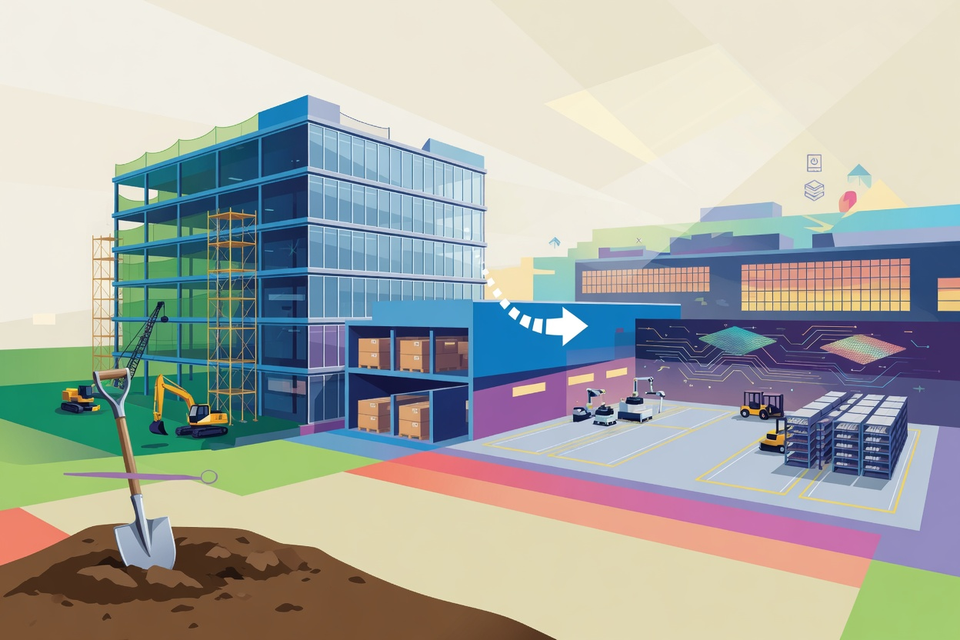
Hitachi Energy has broken ground on a new six-level building at its power semiconductor manufacturing site in Lenzburg, Switzerland. The structure is offices and logistics rather than production floor, and the company's stated route to higher output runs through the space it frees up inside the existing plant.
What is being built is specific. The new building consolidates office functions into a single purpose-built workspace, providing almost 200 workstations along with meeting and focus rooms, a dedicated customer-support area, collaborative zones and improved IT services. The logistics section adds automated storage infrastructure and specialised rooms intended to raise throughput.
Timing will matter more than floor area to anyone specifying grid equipment. Construction of the office areas runs from 2026 through 2027, with logistics-related work continuing into 2028. Hitachi Energy says it will work with the architect, ATP Architekten Ingenieure Zürich AG, together with local authorities and partners, to keep disruption to ongoing production low while the site keeps shipping.
The Lenzburg work sits inside a larger commitment. Hitachi Energy puts its global investment programme at $9 billion, covering added capacity and 15,000 additional people across manufacturing, research and development, and digitalisation. Those are company figures, and the release does not break out how much of either lands at this site.
Power semiconductors are the switching devices inside high-voltage direct current transmission, wind and solar integration, grid stabilisation systems and energy storage. Hitachi Energy names utility, industry, data center and transportation customers as the demand behind the expansion. For data centre operators the connection is indirect but real, because these devices sit inside the transmission and conversion equipment that ties a campus to the grid.
Rainer Kaesmaier, managing director of semiconductors at Hitachi Energy, described the groundbreaking as a step toward strengthening the company's semiconductor footprint and expanding production capacity in a targeted way, and framed the spending as a long-term commitment to Switzerland as a hub for this kind of manufacturing. The company describes the Lenzburg plant as highly automated and says the new building will let it optimise existing production areas by moving office functions out of them.
That is the mechanism worth holding onto. No new wafer line was announced, no output figure was attached to the expansion, and no date was given for when recovered floor space becomes finished devices.
Nothing here shortens power equipment lead times before 2027 at the earliest, and the near-term production gain is whatever the plant recovers when office staff vacate the existing footprint. The announcement is evidence of supplier intent rather than capacity a buyer can schedule against today.




Leave a Reply