
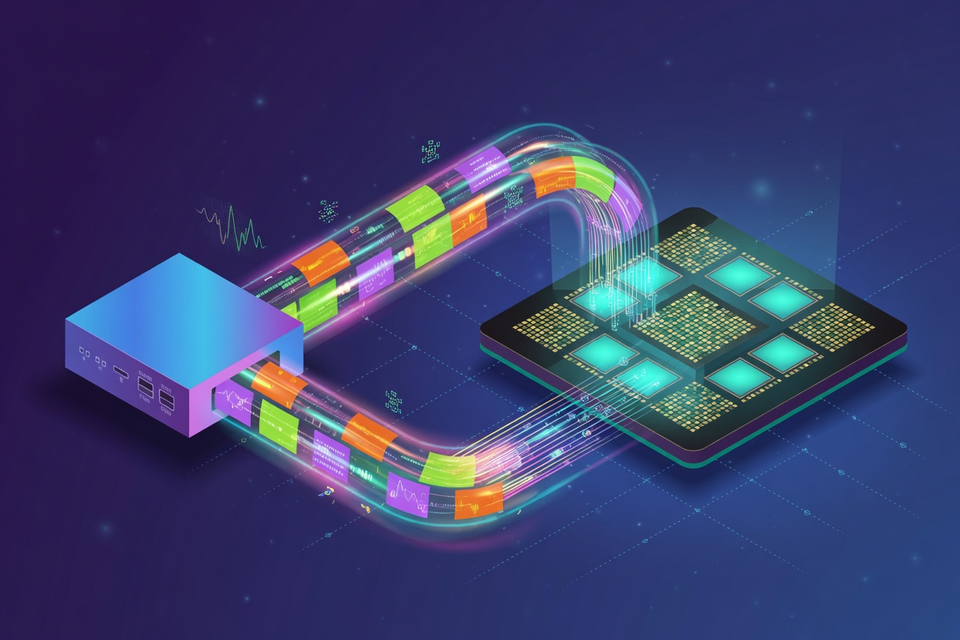
Nvidia has released a networking library with a name that reads like a cocktail order and behaves like bypass surgery. DAQIRI stands for Data Acquisition for Integrated Real-time Instruments, it belongs to the company's Holoscan platform, and a research team at CERN is already using it.
The problem it goes after is older than the current AI cycle. Scientific instruments have run for decades on a simple pattern: collect first, store everything, analyze later. Nvidia's argument is that the pattern was never designed for the rates modern detectors produce. It offers the Linac Coherent Light Source II as its example, a facility the company says generates photon pulses at a 1 MHz repetition rate, alongside industrial CT scanners and high bandwidth software defined radios.
Consider how thin the alternative used to be. AlphaFold2's 2020 breakthrough in drug discovery leaned entirely on roughly 170,000 protein structures that scientists had deposited in the Protein Data Bank since 1971. Half a century of patient collecting to feed one model. Detectors now generate that kind of volume in an afternoon, and the bottleneck has moved from having enough data to being able to keep any of it.
DAQIRI's answer is to stop asking the operating system for permission. Picture the Linux kernel as a mailroom that opens every package, logs it, and walks it upstairs. Fine for ordinary post, hopeless when the loading dock is taking hundreds of gigabits per second. Using the Data Plane Development Kit, a toolkit for handling network traffic outside the kernel, DAQIRI routes data straight from the network card into the GPU's direct memory access buffers with no intermediate copy. Nvidia says the library handles UDP and RoCE v2 traffic at line rates in the hundreds of gigabits per second and higher.
CERN gives the clearest picture of what that buys. The High-Luminosity upgrade to the Large Hadron Collider is designed to raise luminosity tenfold over the original design, and the ATLAS detector's event selection system is being upgraded to cope, still in two stages: 1 MHz of selected events after the first, up from 100 kHz, and up to 10 kHz after the second, up from 1 kHz. Even at those rates more than 99 percent of collisions are rejected in the online system. A project called A-GHOST, led by scientists from CERN Openlab, the University of Chicago and UCL, uses DAQIRI to bring GPUs closer to the raw detector data so the discarded stream can be searched rather than lost. Convolutional auto-encoders, temporal convolutional networks and transformer-based models are planned for testing on prototype hardware.
Follow the hardware and the commercial logic appears. Streaming into a GPU at that rate calls for an Nvidia ConnectX network card, and the compute at the other end ranges from a DGX Spark on a bench to IGX systems, RTX Pro Servers or VR200 racks. The library itself is free on GitHub. The silicon underneath it is not.
Measurement is where the announcement is thinnest. It publishes no throughput figures of its own, pointing instead to a GitHub landing page for benchmarks and examples, and its headline performance claim of full line rate on any interface arrives with a condition attached: the right hardware, and careful tuning of the CPU and memory layout. That last clause is doing more work than it looks.



Leave a Reply