
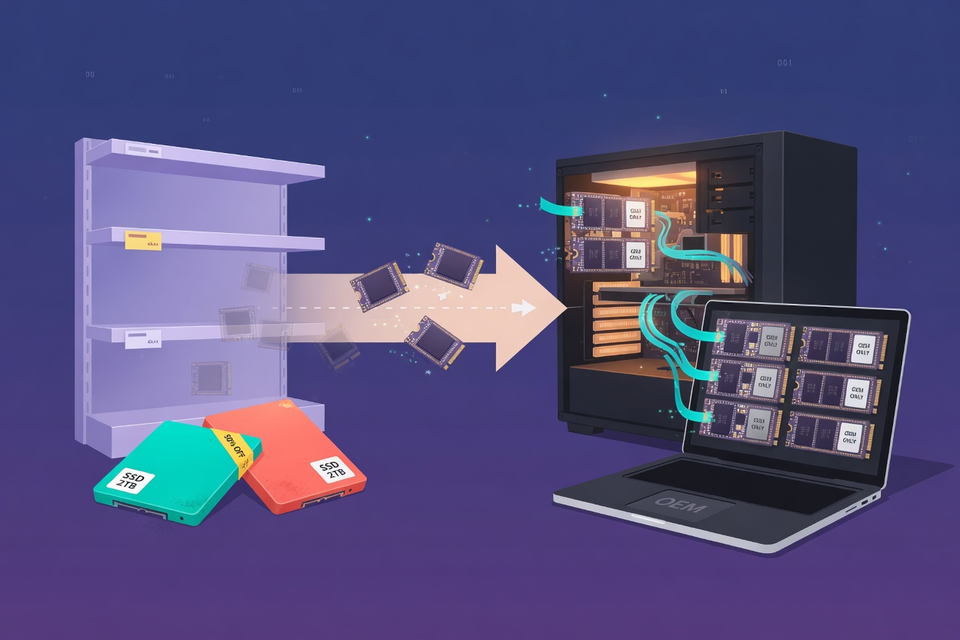
Silicon Motion says the retail SSD market has all but vanished in the first half of 2026, and that the controllers it ships to module makers now end up mostly inside machines built by PC OEMs.
"The retail SSD market has almost disappeared," Nelson Duann, a vice president at the controller maker, told Tom's Hardware at Computex 2026. Read against the rest of his remarks, that is not a demand statement. Retail units did not stop selling because buyers lost interest; they stopped because memory makers pushed the bits at the AI side of the market and the shelf price followed.
Allocation rather than consumption is what he is describing. "The controllers we sell to module makers are now largely ending up in SSDs that are shipped to PC OEMs. The reason is that OEMs cannot obtain enough NAND directly from memory manufacturers, so they are increasingly sourcing SSDs from module makers instead."
Unpack that and it says the tier-one PC vendors have lost their direct line to the fabs. NAND suppliers cut allocation to the client and consumer segment and pushed most of the output at data center product, so PC makers such as Acer, Asus, Dell and HP have to buy finished drives from module houses instead of buying raw flash and building their own. The module channel, which existed to sell heatsinked aftermarket drives to enthusiasts, has been conscripted into the OEM supply chain.
"In the past, most module makers focused on the retail market," Duann said, dating the change to late last year and this year, with OEM demand strong enough that module makers now send a significant share of production straight to PC manufacturers.
For an independent controller vendor this is a good problem. Silicon Motion and Phison sit upstream of the squeeze: server-grade drive demand is rising, and client storage volumes are not necessarily falling in unit terms even as retail sell-through collapses. The bits moved, the channel moved, and the controller still ships either way. What changes is the customer mix and the pricing leverage that comes with it, and a controller vendor whose output lands in OEM systems negotiates with a handful of large accounts rather than a fragmented aftermarket.
Note what is not here. Duann put no numbers on any of it, no unit decline, no allocation percentage, no revenue split between client and server controllers, so the shape of the shift is on the record and its magnitude is not. That is worth holding onto before treating "almost disappeared" as a measurement rather than a characterization.
Bootnote: the module makers now feeding Acer and Dell are the same operation that spent the past decade selling enthusiasts drives with taller heatsinks and better sustained write behaviour than the OEM part in the same laptop. If retail flash comes back, that channel has to be won back from customers who now take the whole production run.




Leave a Reply