
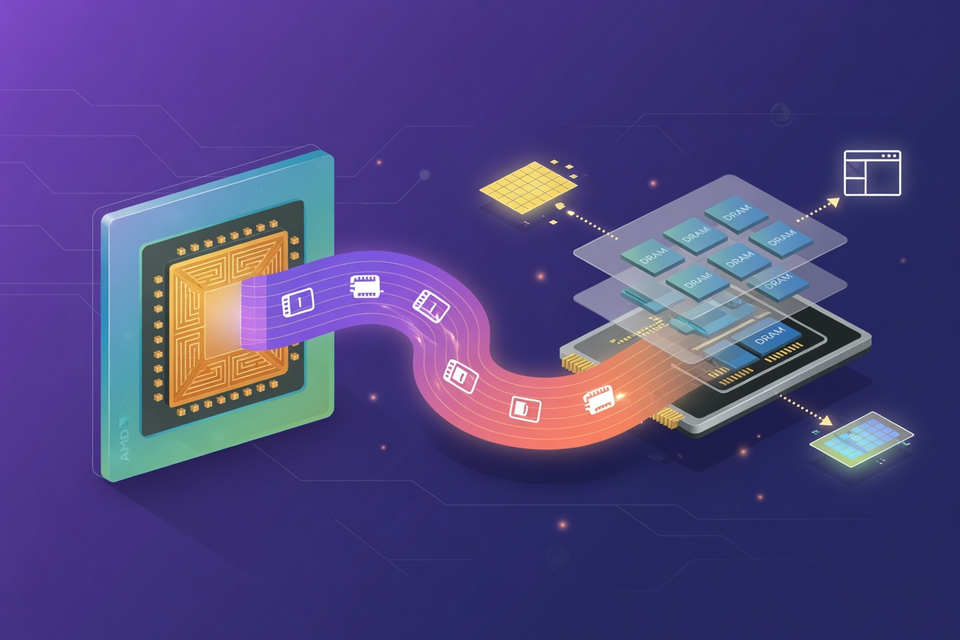
AMD has acquired MEXT, a startup whose memory tiering software presents NAND flash to the operating system as though it were DRAM.
Terms were not disclosed. The announcement carries no purchase price, no headcount and no product date, and Tom's Hardware reports that the terms of the deal are unknown. What did get named is the technology, MEXT's Predictive Memory Engine.
The engine continuously analyzes memory access patterns and uses AI models to anticipate which data held in flash will be needed next, moving those pages back into DRAM before applications request them, according to Tom's Hardware. Software therefore sees main memory throughout while the capacity underneath it is mostly NAND, which Tom's Hardware notes costs orders of magnitude less per unit of capacity than DRAM.
Here is how the company describes it: "MEXT has developed innovative AI-powered predictive memory technology designed to make flash behave more like DRAM, helping expand usable memory capacity while maintaining performance and efficiency."
Read that closely and two phrases carry the weight: flash is to behave more like DRAM, and performance is to be maintained. Neither the announcement nor the Tom's Hardware account supplies a latency figure, a hit rate for the predictor, a named workload or a benchmark. Prefetching works when access patterns are predictable, and the penalty for a miss on this design is a flash read arriving where the application expected a memory reference. Nobody has published what that penalty is.
Note who is buying. AMD sells processors and accelerators, not memory, so every dollar a customer does not spend on DRAM is a dollar still available for compute. MEXT hands AMD a lever on the memory line of a customer's bill of materials without AMD having to manufacture memory, and the company says it plans to fold the technology into its data center product portfolio and extend it toward memory-hungry AI workloads.
On the acquired team, AMD says: "Their innovation and technical leadership will further strengthen efforts at AMD to solve some of the most important challenges facing modern data center buildouts."
That is acqui-hire language, and the skills listed support it. Tom's Hardware puts the team's expertise in memory architectures, infrastructure software and large-scale computing systems, which describes a systems software group rather than a silicon one. Nothing in either account describes a chip.
The claim to watch is not performance. AMD frames the benefit as total cost of ownership and time to deployment, which is the honest claim for a tiering product and also the harder one to check, because it turns on a customer's workload mix and the access traces that go with it. Those traces sit inside the customer, not the vendor, so the first real evidence here will come from an operator publishing a before-and-after on its own fleet rather than from anything AMD releases.
Bootnote: the cautionary statement at the foot of the same announcement lists the availability of components, memory supply among them, as a standing risk factor for AMD. It is boilerplate, it predates this deal and it was not written about it. It is also a fair description of the market the purchase is aimed at.




Leave a Reply