
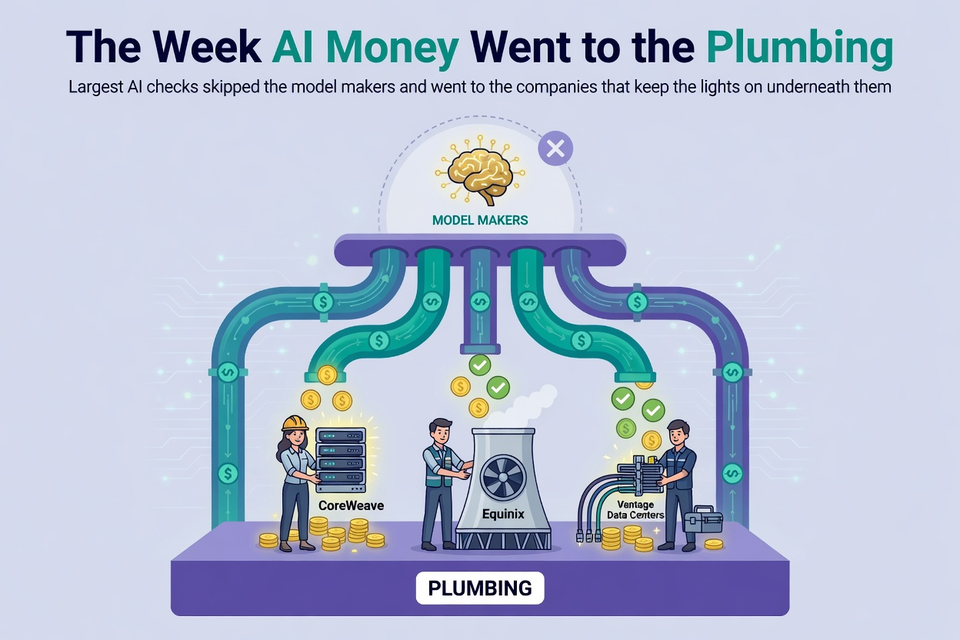
The week's largest AI checks skipped the model makers and went to the companies that keep the lights on underneath them.
Ramp led the tally. The spend management company announced a $750 million Series F valuing it at $44 billion, led by ICONIQ, GIC and Ontario Teachers' Pension Plan, with Goldman Sachs Alternatives and D.E. Shaw among the new names on the register. The company says it grew total payment volume roughly 170 percent year over year in March, its fastest rate in three years, and it is pitching the round on a new cost category: AI tokens. "For 500 years, business ran on two pillars of spend: people and vendors. In the last 24 months, a third arrived – intelligence, paid by the token and invisible to every system we've built to manage cost. Ramp is the infrastructure for the third pillar," said Eric Glyman, co-founder and CEO of Ramp.
Supabase followed a day earlier in spirit and a notch lower in size. The database company raised $500 million at a $10.5 billion valuation including the fresh capital, in a round led by GIC with Accel, Y Combinator, Craft, Felicis, Coatue and Stripe participating. Its back-end tools, built around the open source Postgres database, have become default infrastructure for the vibe-coding crowd, developers who describe an app in natural language and need someone to store the result.
Note the overlap: GIC wrote into both rounds, a sovereign fund positioning itself across two different layers of the same buildout in one week.
The creative end of the market kept pace. Suno, the AI music generation platform, raised $400 million in a Series D led by Bond Capital, with IVP, Forerunner, Union Square Ventures, Alkeon and Quiet joining, at what the company says is a $5.4 billion valuation. The number is the company's own characterization, and it lands while the licensing questions around AI music remain live ones.
Networking rounded out the week. DriveNets, the Israeli company that sells software-based networking to carriers and AI clouds, raised $410 million at an $8.5 billion valuation. The company says it is cash-flow positive with more than $1 billion in backlog as AI demand accelerates, claims that come from the company and have not been independently verified.
Taken together, the week reads as a vote for the unglamorous layers. A payments company reframing itself around token spend, a database vendor riding generated code, and a networking firm selling to AI clouds all raised on the thesis that the constraint on AI is deployment infrastructure rather than model quality. The valuations assume the buildout continues; none of the announcements addressed what happens to infrastructure multiples if it pauses. That question, unanswered, is the price of admission this cycle, and this week four sets of investors paid it without visible hesitation.



Leave a Reply