
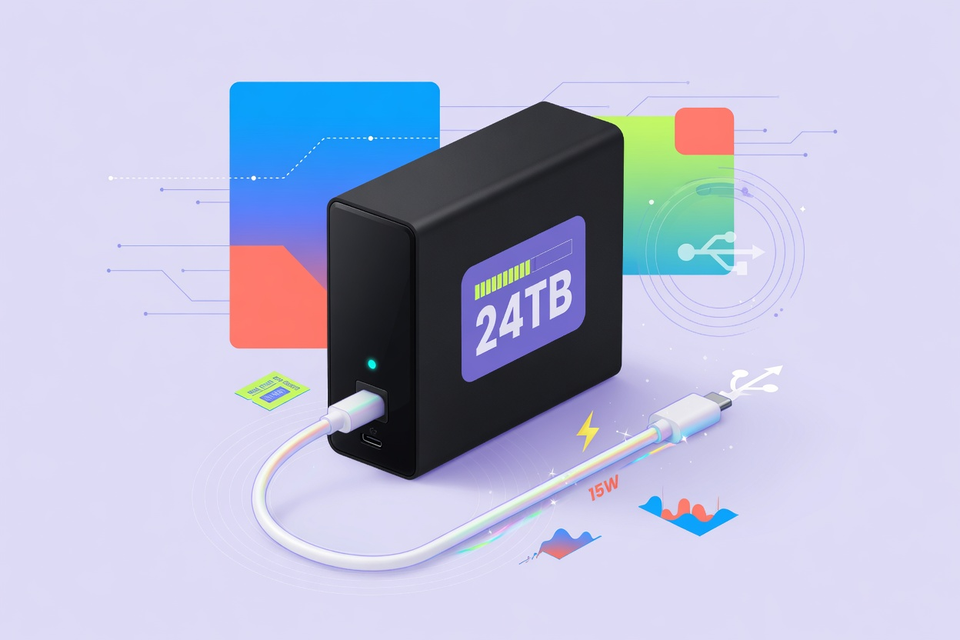
PCWorld has reviewed Seagate's One Touch external 3.5-inch hard drive, and the specification that matters is not in the benchmark charts: this is a full-size desktop drive, offered in capacities up to 24TB, that runs entirely on 15 watts of USB bus power with no AC adapter in the box or the bag.
The reviewer's verdict opens with the market context that makes a spinning-rust review newsworthy in 2026. "With SSD prices still through the roof, the Seagate One Touch USB hard drive is one of the cheapest ways to up your terabyte storage count." That is the whole consumer storage story this year in one sentence: the NAND shortage that has enterprise buyers rationing QLC is the same force sending desktop users back to mechanical drives.
Run the arithmetic on the one SKU shipping now and the appeal is obvious. The tested 8TB unit lists at $260, which works out to $32.50 per terabyte, a figure no consumer SSD approaches. PCWorld notes the price sits $10 under Seagate's own recently reviewed FireCuda X Vault, a near-identical performer, and the review questions why the gap exists at all.
Capacity is where the One Touch stakes its claim. The line was announced at 8TB, 20TB and 24TB, and PCWorld reports the 24TB tier is so far exclusive to this model, with the X Vault topping out at 20TB. For a single USB device with no external power, a quarter of the way to a petabyte in four drives is not nothing.
Performance lands where 3.5-inch USB drives land. PCWorld measured the One Touch roughly 80MBps ahead of the average 2.5-inch portable and about 60MBps behind Seagate's AC-powered Expansion Desktop, trading synthetic wins and real-world losses with the X Vault in what the review calls a standoff. Slothful next to any SSD, in other words, but adequate for backup and media duty, which is the workload the drive exists for.
The 15 watt requirement deserves the specialist's asterisk. Not every USB port delivers it, so the drive effectively assumes USB4, USB 3.2×2, Thunderbolt 3 or a charging-class port, and the review advises checking documentation first. Seagate backs the drive with a two-year warranty that includes two years of data recovery service, a hedge worth having on any mechanical device this dense.
Bootnote: powering a 3.5-inch mechanism through a data cable was a fantasy for most of USB's existence, since spin-up current alone used to demand a wall wart. USB-C power delivery quietly retired that constraint, and Seagate now ships two models exploiting it. Progress in storage is usually measured in terabits per square inch, but occasionally it is measured in one fewer thing to forget in a hotel room.




Leave a Reply