
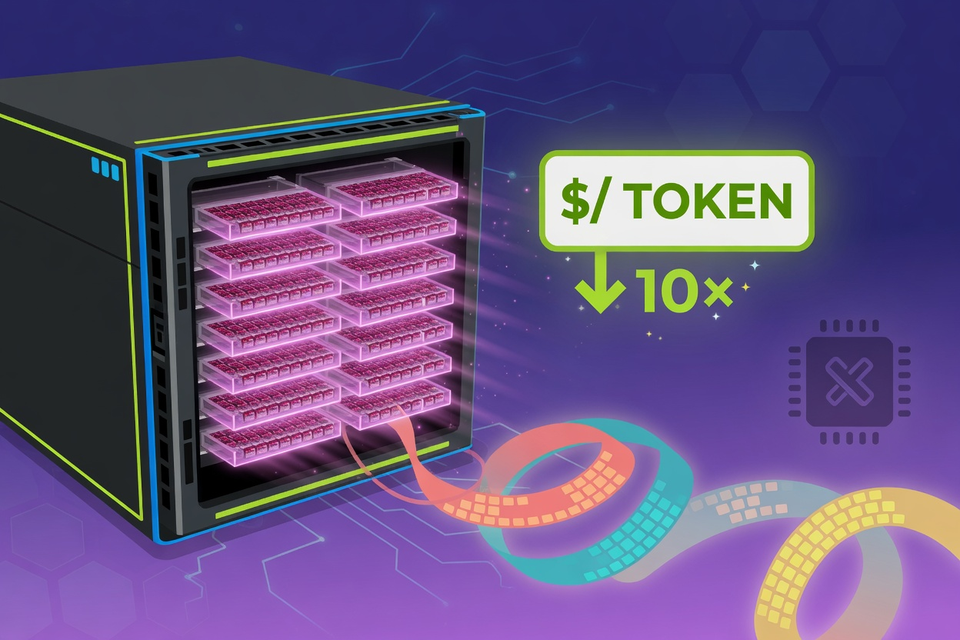
The most quotable number out of Dell Technologies World was not a benchmark. It was a unit price. NVIDIA and Dell used the keynote to introduce the PowerEdge XE9812, a server built on the NVIDIA Vera Rubin NVL72 platform, carrying a claim of up to 10 times lower cost per token than NVIDIA Blackwell for massive-scale agentic AI inferencing.
A token is roughly a chunk of a word, the unit a model emits one after another as it writes. Cost per token is therefore the silicon-and-electricity bill for a single syllable of machine output. Once a company is running agents rather than demos, that bill stops being a rounding error and starts being the budget.
NVL72 means 72 GPUs wired together tightly enough that software treats them as one enormous processor. Picture a rowing eight rather than eight people in separate boats, everyone pulling on the same stroke. The follow-on design, NVIDIA HGX Rubin NVL8, reaches Dell customers as the PowerEdge XE9880L, XE9885L and XE9882L, which NVIDIA says support up to 144 GPUs per rack with 100 percent direct liquid-cooled compute nodes and up to 10 times the performance of HGX B200.
Networking got the same treatment. Dell's new PowerSwitch portfolio uses NVIDIA Quantum-X800 InfiniBand with liquid-cooled, co-packaged optics, which means the optical parts sit on the switch silicon instead of plugging in as separate modules. NVIDIA Spectrum-6 Ethernet covers buyers who would rather not run InfiniBand at all.
There is also PowerRack, sold as compute, networking and storage engineered as one unit, with thermal design, power management and software optimization built to work together from the ground up. That is a quiet admission about where the pain actually sits. Buying components is easy. Getting them to agree on a power and cooling budget is not, and Dell is offering to take that argument off the customer's hands.
On the processor side, the PowerEdge M9822 and R9822 bring NVIDIA Vera CPUs into the same halls. Vera carries 1.2 terabytes per second of memory bandwidth, and NVIDIA puts agentic workloads at 50 percent faster than x86 processors, with Starburst, a new data engine in the Dell AI Data Platform, delivering three times the query throughput for large-scale SQL analytics. Agents spend their working lives interrogating databases, so the machine holding the database matters more than it did when the workload was a chatbot.
Adoption numbers came from Dell's own survey, cited from the keynote stage: 67 percent of AI workloads now run outside the cloud, on premises, on device, at the edge or in colocation, and 88 percent of respondents run at least one AI workload on premises. No methodology was published for either figure, and the counting was done by a company that sells the on-premises hardware. Read them as Dell's own reading of its market rather than an independent measurement.
Sizing the decade, Dell went larger still, telling the room that worldwide AI infrastructure spending could reach three to four trillion dollars by 2030, with token consumption growing 3,400 percent over the same window. Those are forecasts and they may miss badly. The hardware underneath them points somewhere narrower and easier to test, which is that the thing enterprises keep running into is not the quality of the model but the cost and the plumbing of keeping an agent alive in a building they own.


Leave a Reply