
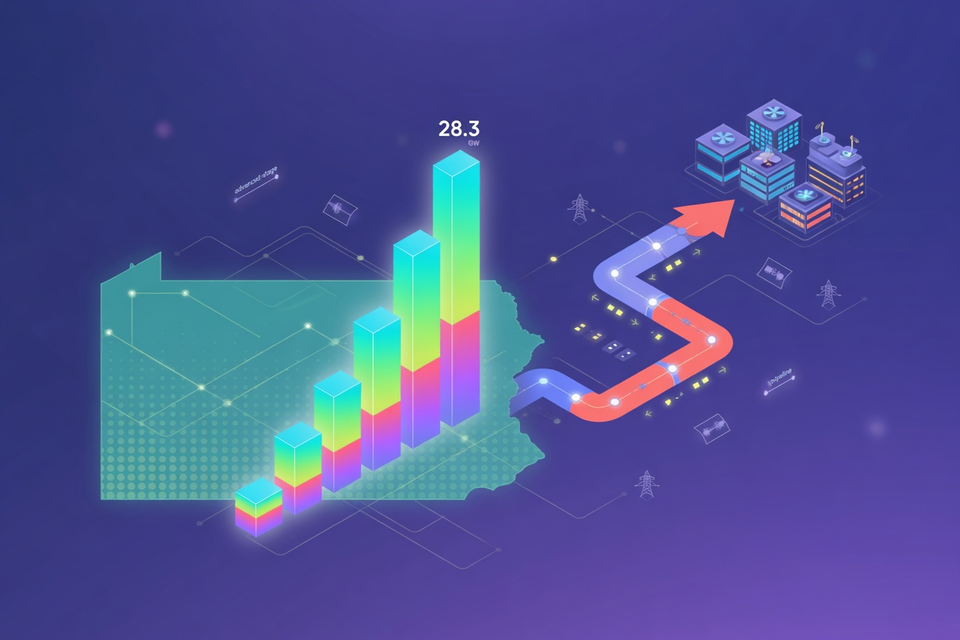
The advanced-stage data center pipeline at PPL has grown to 28.3 GW in Pennsylvania, Utility Dive reports from the company's first-quarter earnings call. That figure is a pipeline rather than contracted load, and the distance between the two is where the useful detail sits.
Advanced stage is a defined category, not a description. Projects in it have signed agreements with developers, and the company says it will be paid for project-related work even if those projects never advance. For anyone assessing how much of a utility's announced pipeline is real, that is the disclosure worth reading twice, because it means the number carries revenue for PPL at a much earlier point than it carries electrons for a tenant.
The ramp is more modest than the headline figure suggests. Roughly 0.6 GW is expected online this year, rising to 20.7 GW in 2030, according to the company's earnings call presentation. About 5 GW of the advanced-stage projects are under construction now.
Named customers in Pennsylvania include QTS Data Centers, Amazon Web Services, PowerHouse Data Centers and CoreWeave, according to Vincent Sorgi, PPL's president and chief executive.
Generation is being handled through a separate, unregulated joint venture with Blackstone Infrastructure, which would build plants to serve data centers rather than adding them to the regulated utility's rate base. On that venture Sorgi said the company is at the reservation stage: "we are executing multiple gas turbine reservation agreements and have submitted requests for multiple generation projects into PJM's interconnection queue". Turbine reservations are financial commitments made years ahead of delivery, and interconnection queue position, not turbine availability, is usually the binding constraint on when a plant can actually run. An initial project announcement could come this year, Sorgi said.
One open question affects what large customers eventually pay. The joint venture could take part in PJM Interconnection's planned reliability backstop auction for large loads, though that depends on rules still being written. "There's quite a bit of work that needs to be done to ensure that the costs that are related to any backstop auction are actually borne by the large loads", Sorgi said, adding that it is not clear as written or as proposed that the company would get that result. Read plainly, the cost allocation for that mechanism is unsettled, and data center operators in the territory do not yet know which side of it they land on.
Kentucky is running a similar pattern at smaller scale. PPL's Louisville Gas and Electric and Kentucky Utilities subsidiaries report an 11.9 GW data center pipeline, up from 8 GW the previous quarter, plus about 1 GW of non-data-center large load. The utilities may ask state regulators later this year to add supply, potentially including battery storage, chosen partly because it can be built quickly, and a 266-MW pumped storage project being developed by Rye Development.
For operators choosing sites, what matters in practice is that queue position and cost-allocation rules, not announced gigawatts, will determine when power is actually available in PPL's territory. Engineers sizing projects should treat the 28.3 GW figure as a measure of developer interest and the 5 GW under construction as the number that reflects committed steel.




Leave a Reply