
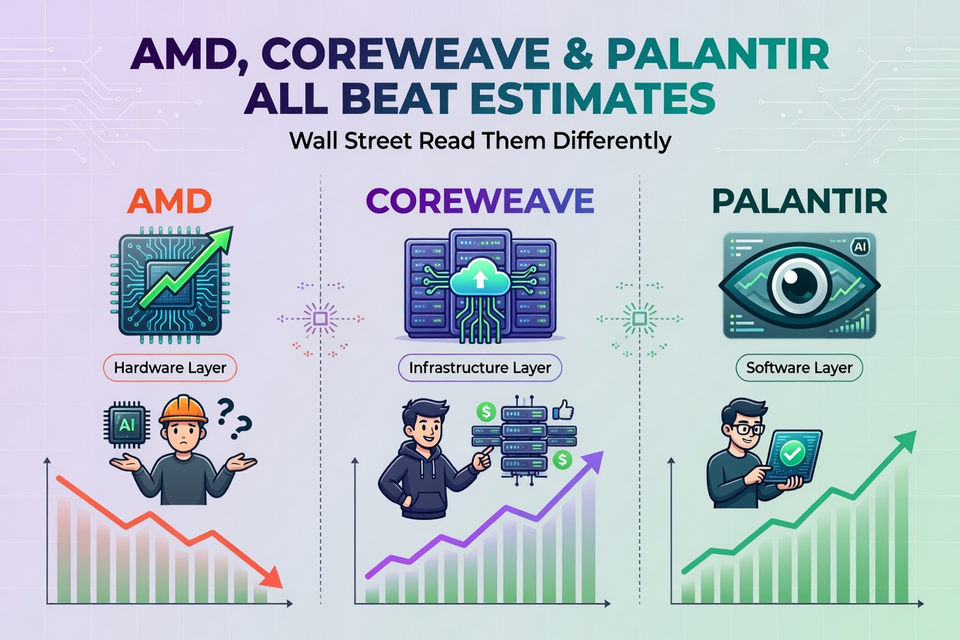
Three companies at different layers of the AI stack reported first-quarter results this week, and the market drew three different conclusions from strong numbers.
AMD posted revenue of $10.3 billion, up 38% year over year, with data center revenue climbing 57% to $5.8 billion on demand for EPYC processors and Instinct GPU shipments. Diluted earnings per share came in at $1.37 on a non-GAAP basis. "We delivered an outstanding first quarter, driven by accelerating demand for AI infrastructure, with Data Center now the primary driver of our revenue and earnings growth," said Dr. Lisa Su, AMD's chair and chief executive. She pointed to strengthening customer interest in the company's coming MI450 chip series and Helios rack system, with shipments due in the second half of the year. AMD reported the results Tuesday, and the stock ripped 16% higher on Wednesday.
CoreWeave told a different story: real growth, but at a cost the market didn't want to underwrite. Revenue more than doubled to $2.1 billion, and revenue backlog reached nearly $100 billion, but the company posted a net loss of $740 million, wider than the $315 million it lost a year earlier, and issued a spending forecast that alarmed investors. "This was the strongest bookings quarter in CoreWeave's history," said Michael Intrator, the company's co-founder and chief executive, citing new commitments including a $21 billion deal with Meta and a multiyear agreement with Anthropic. Shares tumbled as much as 10% in extended trading Thursday after CoreWeave issued light revenue guidance and raised its 2026 capital spending forecast. In an interview with CNBC, Intrator waved off the reaction: "there's this seismic level change occurring in our economy and being driven by these incredible technology companies that are dependent upon the infrastructure."
Palantir's numbers were arguably the strongest of the three, and its stock fell anyway. Revenue grew 85% year over year to $1.63 billion, its fastest growth rate as a public company, with U.S. revenue up 104%. The company raised full-year revenue guidance to 71% growth. Co-founder and chief executive Alex Karp credited the U.S. commercial business for more than doubling. He said: "Palantir's Rule of 40 score has soared to 145%." Reported after the close on Monday, results sent the stock lower on Tuesday anyway, as analysts pointed to valuation, not execution, as the constraint.
The pattern across all three: none of these companies missed on growth. What moved the stock was guidance and cost, not the quarter just closed. AMD's move higher tracked a credible growth story with visible new demand ahead; CoreWeave's and Palantir's declines tracked the price already paid for that growth, and the bill that comes with scaling infrastructure fast enough to keep it. Treating these three moves as a single verdict on "AI stocks" would flatten a distinction the numbers themselves draw clearly.




Leave a Reply