
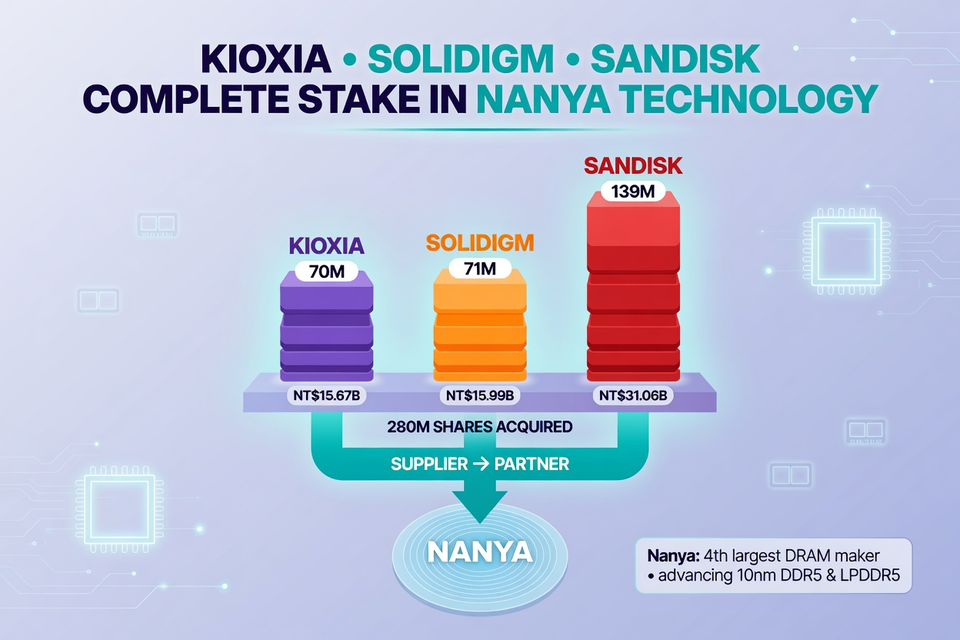
Nanya Technology finished selling stock to three companies it supplies with DRAM. Kioxia, Solidigm and SanDisk subscribed to a combined 280,078,000 common shares of the Taiwanese chipmaker at NT$223.9 apiece, worth NT$62.713 billion, or roughly EUR1.68 billion. SanDisk took the largest slice, 138,685,000 shares worth NT$31.055 billion. Solidigm, the SK Hynix subsidiary built around Intel's former NAND business, bought 71,393,000 shares for NT$15.985 billion. Kioxia subscribed to 70,000,000 shares worth NT$15.673 billion. Nanya is the world's fourth largest DRAM manufacturer, and it continues developing 10 nanometer class process technology aimed at DDR5 and LPDDR5 products.
Those three purchases were part of a larger private placement that also included Cisco Systems, bringing the total raised to NT$78.72 billion, or about US$2.47 billion, across 351.57 million shares. Nanya priced the placement at a small discount to its NT$226.5 closing price the day before, and the deal was scheduled to close April 8. Once it settled, SK Hynix and Kioxia each held a 2 percent stake in Nanya, SanDisk held 4 percent, and Cisco held 2 percent. Nanya's own shares rallied in early trading after the placement was announced, before paring those gains to close slightly lower.
Every buyer had a reason to want equity in a DRAM supplier beyond the return. SanDisk signed a multi year agreement to buy DRAM from Nanya alongside its investment. Kioxia entered a separate long term DRAM supply deal, citing growth in its solid state drive business and a need to lock in memory it does not manufacture itself. Neither company produces DRAM at meaningful scale on its own, and both compete on selling finished SSDs that pair NAND flash with DRAM for caching and buffering.
Liu Pei-chen, an economist at the Taiwan Institute of Economic Research, told CNA the move goes beyond a financial bet: it strengthens each investor's position in artificial intelligence development. She said Taiwanese memory suppliers such as Nanya are moving past the role of subcontractor to foreign customers, and that SK Hynix in particular stands to gain from Nanya's technology base as it pushes further into high bandwidth memory, the DRAM variant used in AI accelerators. Static random access memory, another area of strength for Taiwanese suppliers, could raise the island's profile in AI hardware further still, she added.
Whether any of this changes Nanya's standing against Samsung or Micron over the coming quarters would depend on how fast it converts the new capital into shipped output, not on the size of the placement by itself. For now, the deal hands Nanya cash for advanced memory manufacturing and gives its buyers a direct line into DRAM supply while AI infrastructure spending keeps memory prices elevated.




Leave a Reply