
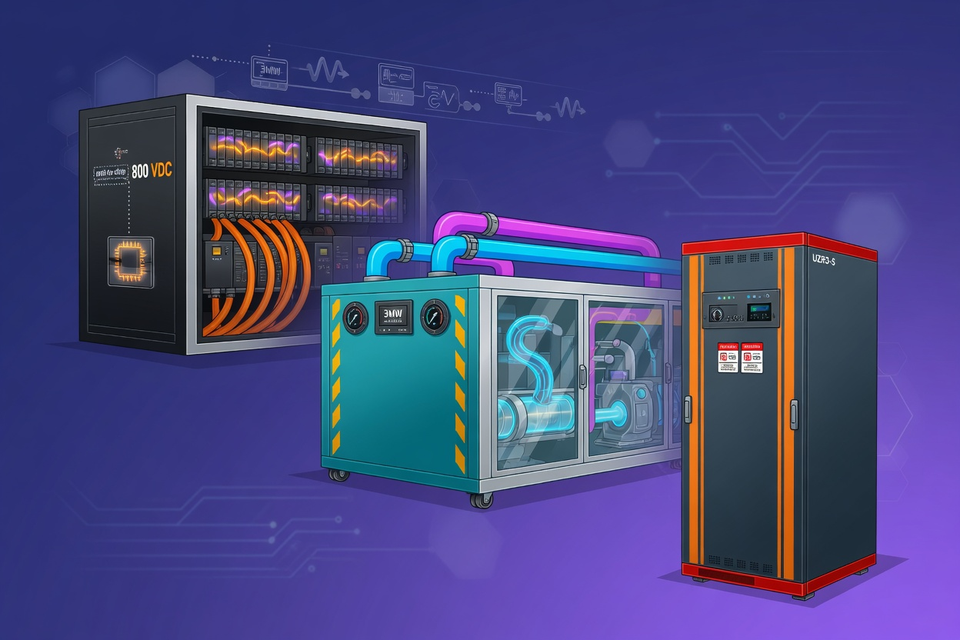
Delta is taking a full grid-to-chip stack for AI data centers to Data Center World 2026 in Washington, DC, where the show runs from April 20 to 23 and the company is at booth 212. The one genuinely new item is the UZR3-S lithium-ion battery cabinet, built to meet the Large-Scale Fire Testing requirements in NFPA 855. Around it sits an updated uninterruptible power supply line, a 3MW coolant distribution unit, an 800 VDC rack power design and a building management layer.
The uninterruptible power supply at the heart of the stack is the Ultron DPM Gen-2 series, a three-phase platform running from 250 to 2500 kVA in 415V and 480V configurations. Delta says silicon carbide switching takes it to 97.5 percent efficiency in double conversion mode, and that the design scales to 20 MW with N+1 redundancy. That efficiency figure is the company's own and is not attributed to a third-party test house.
Battery is where the compliance argument sits. The existing UZR3 cabinet is UL1973 certified, passed UL9540A testing with zero fire propagation, and reaches UL9540 certification when paired with the DPM Gen-2 uninterruptible power supply. The new UZR3-S adds fire mitigation and thermal management aimed at NFPA 855 Large-Scale Fire Testing, which matters to any operator whose local fire code has caught up with lithium-ion energy storage inside an occupied building.
On the thermal side Delta is showing a 3MW liquid-to-liquid coolant distribution unit rated at up to 3000 kW and flow rates up to 3000 liters per minute, with dual power input, hot-swappable filtration and monitoring over SNMP, Modbus TCP/IP and BACnet. That is a central plant approach: one large unit feeding many racks.
Compare it with the route OptiCool and Belden have taken, packaging rear-door heat exchangers into Belden racks for retrofits into existing white space, which Data Center Dynamics reports supports up to 120kW per rack. Buyers running a hall of legacy cabinets face a real choice between a rack-by-rack retrofit and a centralized unit sized for a whole row.
Moving to 800 VDC is the piece with the longest lead time. Putting DC power shelves and distribution inside the rack delivers up to 1.1 MW per rack at up to 98 percent efficiency, according to the company, with eFuse protection and a busbar design intended to avoid a wider electrical redesign upstream.
Above all of it runs enteliWEB, Delta's building management system, with Red5 controllers handling thermal and electrical systems across white space and grey space, and O3 multi-sensors reporting temperature, humidity, light and sound. Red5 supports Python and Node-RED, which is the detail worth noting for anyone who has to integrate a controller with existing site tooling.
Victor Lee, Delta's senior vice president of data center strategic business platform, said: "At Delta, we design infrastructure as a unified system, not as disconnected components. By integrating power, cooling, and controls into a single architecture, we help customers eliminate complexity, improve efficiency, and scale confidently for the next generation of AI workloads." The announcement carries no pricing for any of the products named, no availability or shipping dates, and no stated lead times, so the unified system cannot yet be costed against a mixed-vendor build.
For buyers, the practical question is whether single-vendor responsibility across power, cooling and controls is worth giving up per-component selection. Delta has not published the numbers that would settle it, and until it does, the UZR3-S fire-test compliance is the one claim on this list that an operator can check against a code requirement.




Leave a Reply