
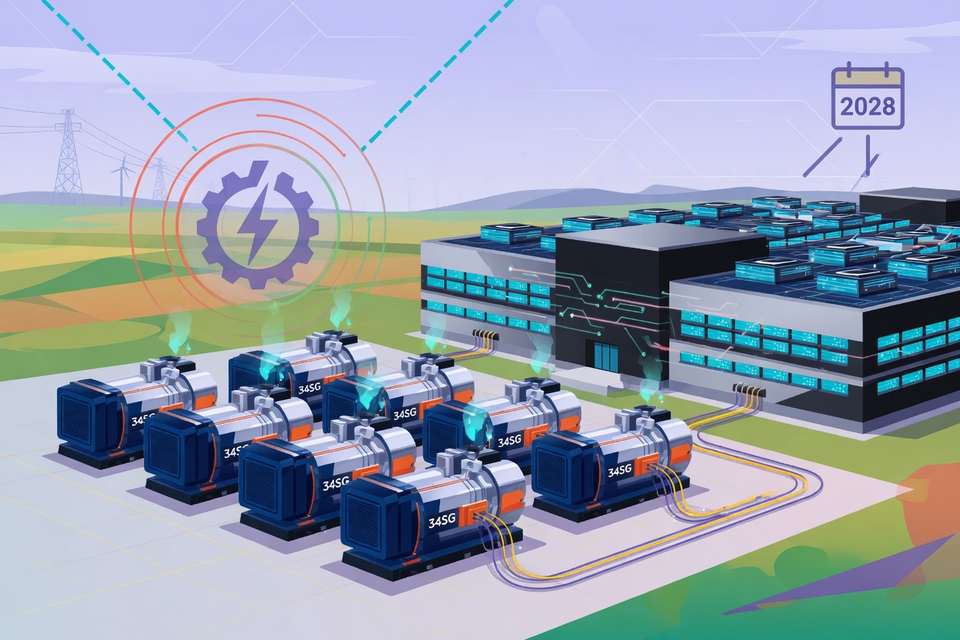
Wärtsilä has received an order to supply 412 MW of engine power to a hyperscale data center project in Ohio, made up of 40 of its 34SG spark gas engines. The plant is being built to provide primary power, not standby, so the site can operate off-grid and skip the interconnection queue entirely. Equipment deliveries are scheduled to align with an anticipated commercial operation date of early 2028.
That is the part buyers should read twice. Onsite reciprocating engines have historically been sized for outage coverage measured in hours, with the utility carrying the base load; here the engines are the base load, and the grid connection is not part of the announced design at all.
At 412 MW across 40 units, each engine is carrying a little over 10 MW. Wärtsilä says the 34SG's modular design suits developers who want power delivered in blocks and scaled up past 500 MW, and it lists low water consumption and performance in high-temperature environments among the reasons the model fits data center duty. This is the first time the 34SG has been sold into a data center application.
"The customer chose Wärtsilä for its proven reliability, rapid deployment, and strong operational efficiency across diverse operating conditions," said Risto Paldanius, Vice President, Americas at Wärtsilä Energy. What that sentence does not settle is the commercial shape of the deal. The end customer is not named, no contract value is disclosed, there is no published heat rate or emissions figure for this configuration, and the release says nothing about who is securing the gas supply or the pipeline capacity to feed 40 engines continuously.
Buyers weighing engines against turbines now have live comparators. Power Engineering reports that PROENERGY has contracted to supply Crusoe with 13 PE6000 aeroderivative gas turbine generator sets rated at 50 MW each, an aggregate 650 MW that PROENERGY test-fits at its Sedalia plant before shipment to compress commissioning schedules. The same report describes a framework agreement between INNIO Group and Rehlko covering 1.25 GW of Jenbacher engine capacity over three years, and an earlier Nscale project using Caterpillar G3500 reciprocating engines for 2 GW of onsite generation in West Virginia.
The trade-off between those two families is granularity against footprint. Reciprocating engines in the 10 MW class give an operator fine-grained capacity steps and part-load flexibility at the cost of more units to maintain, while 50 MW aeroderivative sets cut the unit count by a factor of five and shift the maintenance burden toward fewer, larger overhauls. Neither route escapes the same two gating items: a firm fuel contract and an air permit.
Cumulative engine capacity sold into the US data center market now stands at over 1.6 GW by the vendor's own count, and the Ohio deal is described as its fourth data center related order in the country. The order was booked as intake in the second quarter of 2026, which places the revenue recognition well ahead of the 2028 operating date.
For infrastructure buyers, this order sets a reference point for what off-grid primary power at hyperscale now looks like in procurement terms: roughly 10 MW building blocks, a lead time of under two years from order to operation, and no dependence on an interconnection study. Engineers evaluating a similar site should treat the missing fuel supply and permitting detail as the open questions, because those, not the engines, are what usually move the commercial operation date.




Leave a Reply