
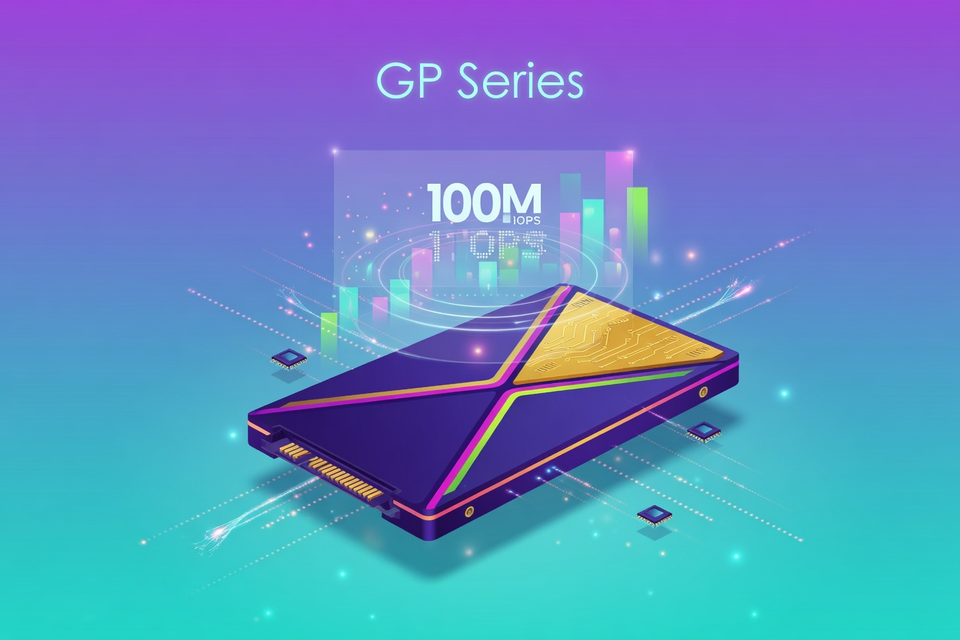
Kioxia has given its Super High IOPS SSD project a product name, the GP Series, and a schedule that begins with first-generation sample shipments in late 2026.
Read the schedule carefully, because the headline number is not attached to the first drive. The company says the first-generation GP Series part is developed to the PCIe 6.0 standard, while the second generation is targeted at a PCIe 7.0 intercept to achieve 100 MIOPS, with an expected release sometime in 2027. That puts the 100 million IOPS claim two product generations and roughly a year and a half out from anything a buyer can evaluate.
What exists today is an emulator. Kioxia says a conventional SSD on its demonstration display runs around 13 MIOPS while the emulated Super High IOPS device exceeds 107 MIOPS, and describes the emulator's purpose as giving developers early access to a target device so they can prepare their software stacks. That is a useful thing to build. It is not a drive.
The baselines in the same document do not agree with each other. One section states that even high-end SSDs for data centers reach only about 6 MIOPS; the emulator section puts a conventional SSD at around 13. No part number, capacity, queue depth or block size accompanies either figure, and the 100 MIOPS target is specified at 512 byte random reads, a block size chosen because it flatters random-read IOPS.
Underneath the number sits a real engineering case. HBM capacity is the binding constraint on model size, context length and concurrent users, and Kioxia's argument is that open-source work such as Big Accelerator Memory, which allows direct data access between GPUs and SSDs, lets flash absorb part of the load HBM has carried. The company also says it is working to develop SSDs that align with the NVIDIA Storage-Next initiative, which is a statement about direction rather than a qualification win, and should be read that way.
Kioxia's own framing for the problem is GPU starvation, the case where expensive accelerators sit idle waiting on random reads from slow storage. Random access is what matters here, not sequential throughput, which is why the pitch is built on IOPS at small block sizes rather than gigabytes per second.
The fine print on the same page is the most honest line in it. "The product release plan is based on information as of April 2026, and the product specification and the schedule is subject to change without notice." Translated for anyone modelling a 2027 refresh: the GP Series roadmap is a statement of intent, the 100 MIOPS figure has been demonstrated only in emulation, and the PCIe 7.0 dependency puts the second generation at the mercy of a platform timeline Kioxia does not control.
Bootnote: the other Kioxia part in this story is XL-FLASH, the company's low-latency flash aimed at the performance gap between DRAM and conventional NAND. Kioxia first showed the Super High IOPS concept during a keynote at the Future of Memory and Storage conference in Santa Clara last year, where the device was an emulation then too.




Leave a Reply