
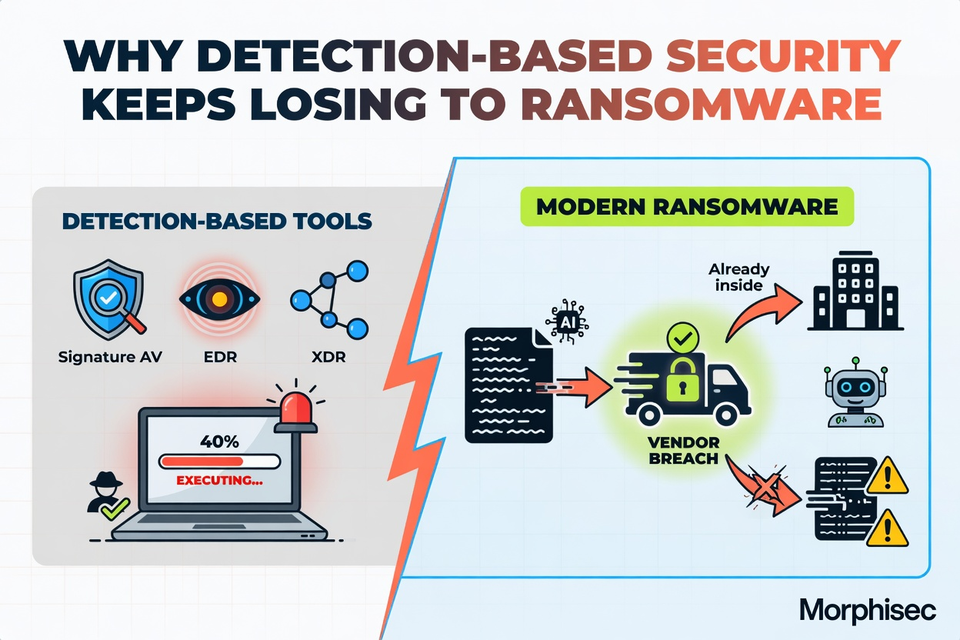
Signature-based antivirus, endpoint detection and response, and extended detection and response all share a structural weakness, according to Morphisec: they identify ransomware by watching it act, which means the software has already started executing before any alarm sounds. Morphisec chief marketing officer Brad LaPorte writes that modern ransomware has moved past the pattern those tools were built to catch, using fileless techniques, automation driven by AI, and targeted intrusions through supply chain vendors rather than direct attacks on a company's own perimeter.
Ransomware-as-a-service has lowered the bar for who can run a campaign, LaPorte argues, letting operators buy access to ready-made attack kits instead of building their own. Attackers who study how detection tools operate can route around the gaps in visibility those tools leave behind, using techniques such as telemetry tampering, safe-mode encryption and methods built specifically to bypass endpoint defenses. Supply chain targeting compounds the problem, in this account, because a compromise at a vendor can reach every downstream customer running that vendor's software, well outside the perimeter any single company's security team actually monitors.
A newer problem, in Morphisec's telling, is what LaPorte calls shadow AI: employees running AI agents and tools without IT department oversight. Those unsupervised tools become a delivery path for ransomware that conventional security stacks were never built to watch, since they were designed around file systems and network traffic rather than AI-driven workflows. Morphisec sells what it calls Adaptive AI Defense to address that gap specifically.
The company's pitch is prevention over detection: stop ransomware from executing at all, rather than catching it once it has started. Morphisec backs the approach with what it calls a Ransomware-Free Guarantee, offering a full refund on the subscription and incident response support if a customer using the platform is breached anyway.
Richard Rushing, chief information security officer at Motorola, is quoted in Morphisec's own materials describing the effect on his team: "Morphisec prevents attacks from actually happening, it gives us an early warning sign… and that lets me make informed, intelligent decisions."
The argument mirrors a debate playing out across the security industry more broadly, where prevention-focused vendors have pushed back against the assumption that breaches are inevitable and detection speed is the only lever worth pulling. Morphisec's case rests on its own framing of the problem and its own product as the fix, and the company has not published independent test results or third-party benchmarks alongside the claim. Enterprise security buyers evaluating prevention-first tools still have reason to ask how those systems perform against attack techniques not yet cataloged, since a tool built to stop known execution patterns faces the same fundamental question that older detection tools did.



Leave a Reply