
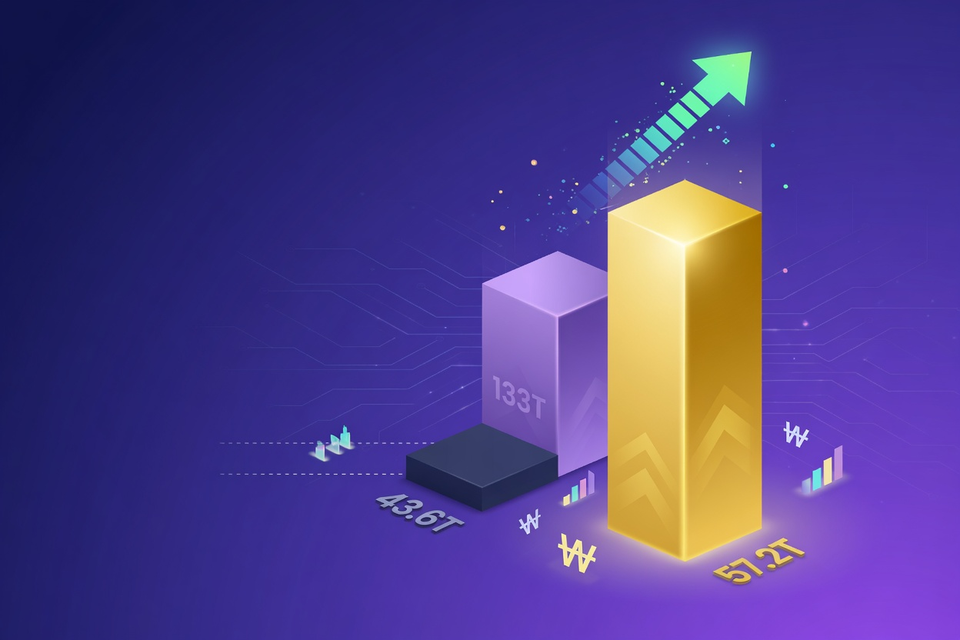
Samsung Electronics has guided to a first quarter operating profit of 57.2 trillion won on sales of 133 trillion won, more than the 43.6 trillion won it earned across the whole of 2025.
Korean disclosure rules bar a company from publishing an earnings estimate as a range, so the headline figure is the median of one. The filed ranges are 57.1 trillion to 57.3 trillion won of operating profit on 132 trillion to 134 trillion won of sales. Set against the year-ago quarter's 6.69 trillion won, that is a rise of 755 percent, and against last quarter's 20.07 trillion won it is nearly three times over.
Consensus never got close. The Korea Times puts the brokerage average at 38.1 trillion won of operating profit and 117 trillion won of sales, while Reuters placed the LSEG SmartEstimate at 40.6 trillion won, as Quartz relays it. Analysts landed on calling the guidance a "super surprise", which is Seoul shorthand for a model wrong on structure, not just magnitude.
Guidance carries no segment breakdown, which is where the interesting estimate sits. Meritz Securities analyst Kim Sun-woo reckons the memory business alone cleared more than 54 trillion won in operating profit while foundry and chip design ran an operating loss of 1.6 trillion won. Read the pair together: Samsung's non-memory silicon is still losing money at the top of the strongest memory market anyone has traded.
Price did the work, not bits. "Prices of both DRAM and NAND are estimated to have surged by more than 90 percent," Kim said. Close to doubling average selling prices across two product lines inside a quarter is a scarcity result, not a demand result, and it explains how a 68 percent sales gain became a 755 percent profit gain.
The contract structure matters more than the headline number. Second quarter DRAM contract prices are being negotiated at more than 30 percent above first quarter levels, and three to five year agreements are being signed with floors set above first quarter prices, the Korea Times reports. Hyperscalers are buying insurance against not having parts, and have pre-sold Samsung much of the next cycle's downside.
Momentum extends past the AI-specific parts. Samsung has begun shipping mass-produced sixth-generation high bandwidth memory, HBM4, while prices for legacy DRAM used in servers, PCs and mobile devices rose sharply as well.
Counter-evidence exists, and the guidance has blunted it. The bear case had been Google's TurboQuant, which reduces the memory an AI workload consumes, plus a suspected peak in memory prices and supply chain risk from the Middle East conflict. Daishin Securities analyst Ryu Hyung-keun is unmoved: "In the second quarter of 2026, a surprise is expected in memory chips for mobile devices, as major mobile clients are accepting higher prices," he said, pointing to Samsung's heavier mobile exposure than its competitors.
Kim's own caveat is the sharper one. "Though it was an all-time high, the latest earnings also need to be viewed in the context that the current memory cycle is only approaching the mid-cycle stage," he said. Morgan Stanley makes a version of the same argument from the share price, noting the stock is up 61 percent this year against the KOSPI's 29 percent. Audited figures, with the segment split that would settle the Meritz estimate, arrive on the April 30 earnings call.
Bootnote: the single-number guidance is a regulatory artefact, not a house style. Korean rules do not allow earnings estimates to be offered as a range, so Samsung files a range and discloses its median, which is why its preliminary numbers arrive as one suspiciously precise figure rather than a band.




Leave a Reply