
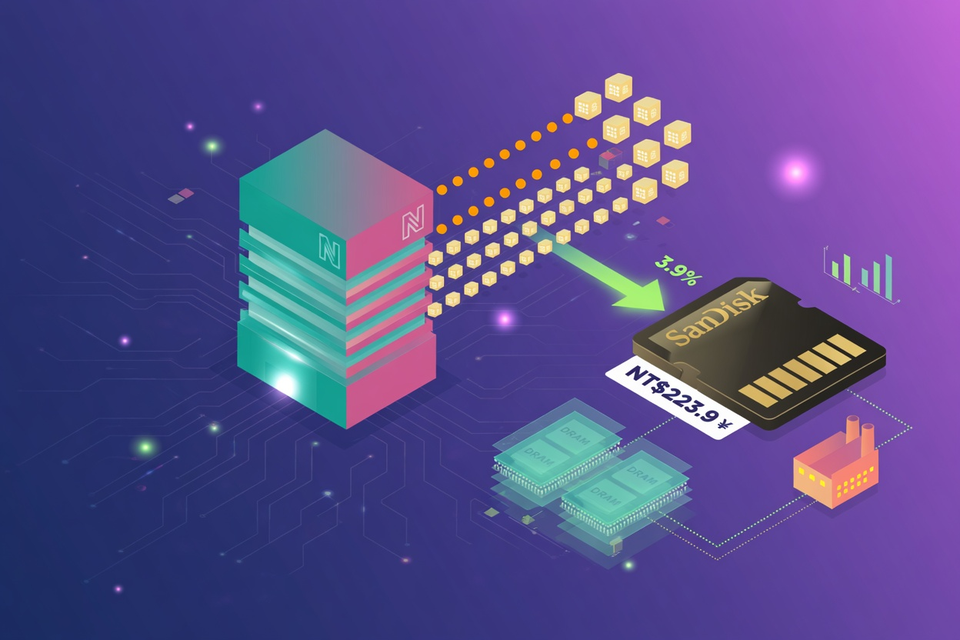
Nanya Technology has agreed to issue 138,685,000 new common shares to Sandisk Technologies at NT$223.9 each, a total of NT$31,051,571,500, and to supply the buyer with DRAM under a separate multi-year arrangement.
That is not reconstruction from coverage. Sandisk filed the subscription agreement itself as Exhibit 10.1 to a Form 8-K, so the share count, the per-share price and the total are the parties' own signed numbers rather than anyone's derivation.
The 8-K summarises the equity leg as "approximately 139 million shares of Nanya common stock for an aggregate purchase price of approximately $1.0 billion", about 3.9 percent of Nanya on a fully diluted basis once the transaction settles, struck at a 15 percent discount to the 30-day average trading price. It runs under Article 43-6 of Taiwan's Securities and Exchange Act, which carries a statutory lock-up of three years from delivery. Whatever memory pricing does over the next three years, that block does not move.
Read the supply leg twice, because it is the reason the equity exists. The filing describes "a multi-year strategic supply arrangement pursuant to which Nanya will supply the Company with DRAM products". In Sandisk's own words: "The supply arrangement is intended to support the Company’s long-term DRAM sourcing strategy." A NAND company with no DRAM fabs has paid a billion dollars for a place in a DRAM supplier's allocation queue, which is a fair measure of what allocation now costs.
Tokyo produced a matching document. Kioxia Holdings disclosed that its subsidiary Kioxia Corporation subscribed for 70,000,000 shares at TWD 15,673,000,000, about 77.4 billion yen at the 4.94 conversion rate the filing uses, with a contract conclusion date of 25 March and a planned payment date of 8 April. Divide the amount by the shares and the price is NT$223.9, exactly what Sandisk agreed.
Together the two filings document 208,685,000 shares and NT$46,724,571,500. Trade coverage sizes the whole placement at roughly NT$78.7 billion across four subscribers, adding SK hynix's Solidigm and Cisco Systems, but no filing from either could be retrieved, so those two tranches sit as reported rather than documented.
Why flash buyers are capitalising a DRAM maker is answered in Kioxia's disclosure, which ties the subscription to SSD demand and to securing medium- to long-term supply of DRAM as a key component. Kioxia also states that the effect on its own results for the fiscal year ending March 2026 is minimal, which is the tell. This is a supply-chain instrument wearing an equity costume.
The financials Kioxia filed on its new investee are the sharper read. Nanya lost NT$7.44 billion attributable to owners of the parent in the year to December 2023 and NT$5.08 billion in 2024, then earned NT$6.61 billion on revenue of NT$66.59 billion in 2025, for basic earnings of NT$2.13 a share. Two documented tranches of a single placement come to seventy percent of that revenue line.
Bootnote: Nanya was incorporated on 4 March 1995 and its register is still a Formosa Plastics group document. Kioxia's filing lists Nan Ya Plastics at 29.28 percent, with Formosa Chemicals and Fibre, Formosa Plastics and Formosa Petrochemical each at 10.81 percent. The four NAND and networking buyers are arriving as minority guests in a petrochemical family holding.




Leave a Reply