
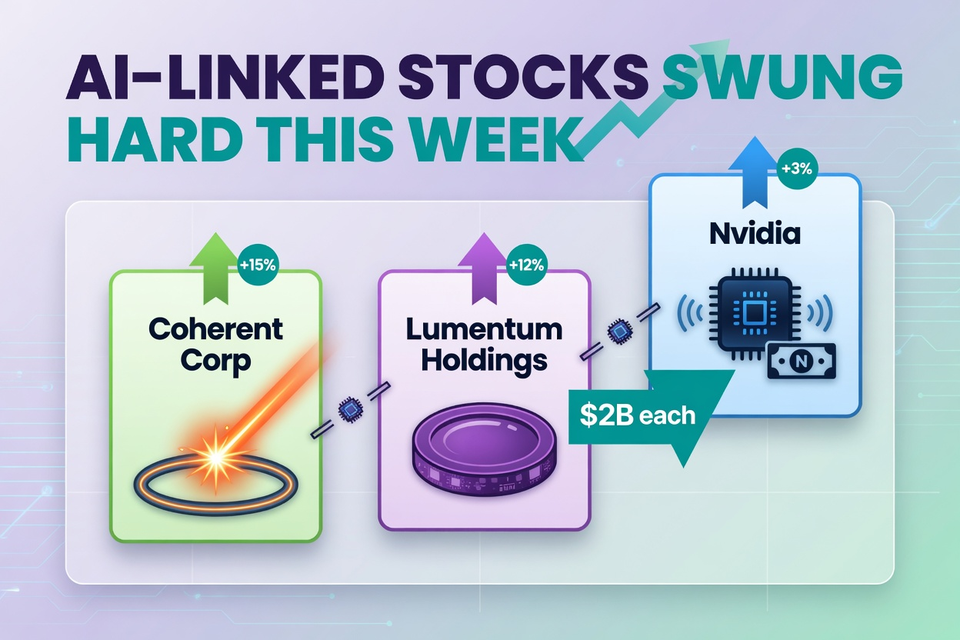
Lumentum Holdings closed nearly 12% higher and Coherent Corp jumped 15% on March 2, the trading session after Nvidia said it would invest $2 billion in each company to expand their optical and laser manufacturing. Nvidia's own shares added about 3% the same day, a modest move for the company writing the checks.
Two days later, Broadcom posted its own share-price jump. The company reported first-quarter revenue of $19.3 billion, up 29% from a year earlier, and its stock rose 5% in extended trading once the results were out. Chief executive Hock Tan told investors that AI revenue reached $8.4 billion for the quarter, up 106% year over year, and forecast $10.7 billion for the following quarter.
That $8.4 billion figure appears once in Broadcom's earnings release, inside Tan's own remarks. The release's financial tables do not carry AI revenue as a separate line item, so the number driving Wednesday's stock move is a company-reported figure rather than an audited segment disclosure. Finance chief Kirsten Spears tied the results to how the company treats its own stock. "Consistent with our commitment to return excess cash to shareholders, we returned $10.9 billion in the first quarter through $3.1 billion of cash dividends and $7.8 billion of stock repurchases," she said. Broadcom also authorized a new $10 billion buyback alongside the earnings report, a second source of demand for its shares beyond the one-day rally.
The week's mood reversed the next day. Memory and storage stocks fell sharply on March 3 as a broader market selloff, tied to fears over an escalating conflict involving Iran, wiped out gains across the sector. Seagate declined more than 7%. Micron and Western Digital dropped more than 8%. Sandisk fell more than 9%, giving back ground after already doubling in value earlier in the year and ranking as the best performer in the S&P 500. Semiconductor equipment makers Applied Materials, Lam Research, KLA and ASML were also all down more than 6% that day, even though none of them reported new earnings or announced anything specific to justify the drop.
Different companies and different triggers, an investment on one side and an earnings beat on the other, produced the same investor reaction on March 2 and March 4: buy immediately. The memory selloff in between argues against reading either rally as confirmation that AI infrastructure spending has become insulated from broader market swings. Nothing in this week's trading resolved which read is correct, and none of the four companies whose shares fell on March 3 make optical components or custom AI accelerators, the specific corners of the market that had rallied days earlier.




Leave a Reply