
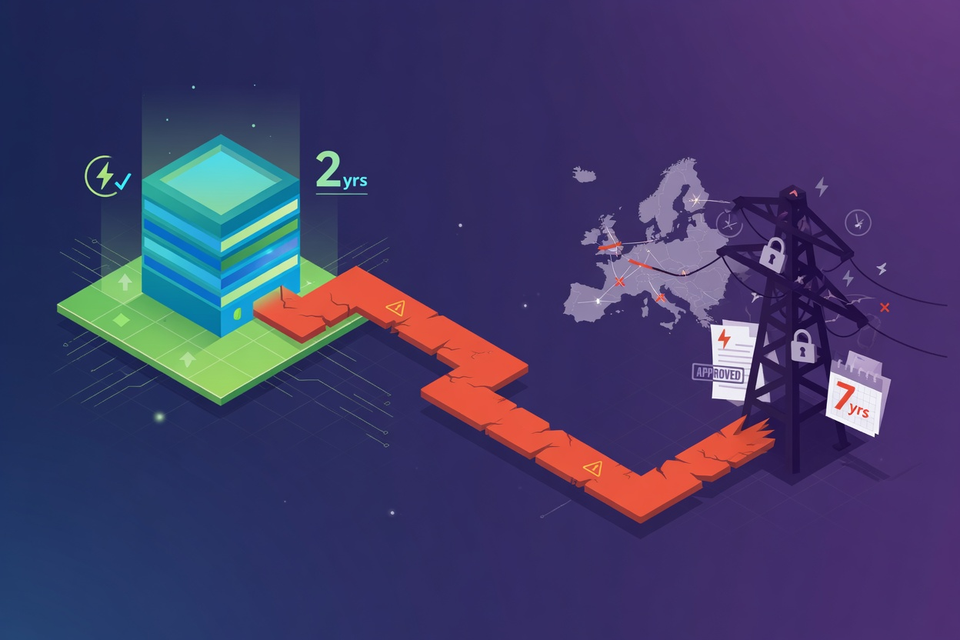
Amazon Web Services can bring a new European data centre online in about two years, but securing power for it can take up to seven. Pamela MacDougall, who leads energy markets and regulation for AWS in EMEA, gave that figure to Reuters, and The Register reports that the gap has forced the company to reassess its European buildout.
The seven-year figure is a queue position, not a construction estimate. It measures how long a transmission operator takes to deliver a firm connection at the requested capacity, and it runs on its own clock, separate from planning permission, land acquisition and the building itself.
Some markets are worse. The International Energy Agency puts the wait in Frankfurt, London, Amsterdam, Paris and Dublin at as much as a decade, and those are the five largest colocation markets on the continent.
This is not only a European problem. A 2025 IEA report placed average US grid connection lead times at one to three years, though The Register notes that Northern Virginia is also pushing seven.
The company disputes the framing rather than the numbers. "Amazon continues to rapidly expand its infrastructure across Europe, with ongoing investments in edge locations and data center regions in more than 20 countries, as part of our global strategy of investing aggressively in capacity for our customers," a spokesperson told The Register by email. The statement does not give a delivery date for any specific European region, which is the variable a buyer signing a multi-year commitment has to plan around.
A second passage in the same statement pointed to capacity already secured. "During our Q3 2025 earnings cycle we shared that we've added more than 3.8 gigawatts of power in the prior 12 months, more than any other cloud provider, and we're on track to double our capacity again by 2027," the spokesperson said. That number is global rather than European, and Amazon has not published a regional split of it.
Density explains why the queue matters more than it did. Typical rack draw has climbed from 6 to 12 kW to upwards of 140 kW, with 600 kW systems expected to follow, so a hall that once needed a few megawatts now needs tens of them at the meter. Training workloads also swing from a couple of percent utilisation to full draw in a fraction of a second, which gives utilities very little time to respond.
Permitting is the one lever with a live legislative fix. The European Commission has proposed rules to stop the grid permitting process exceeding two years, which would compress one part of the delay without producing any additional transformers, cable or turbines, all of which remain in short supply.
One response has been to buy generation outright. Amazon acquired Talen Energy's Cumulus data centre campus next to a nuclear plant, and it has joined the Green Industrial Grids Association, which is a lobbying position rather than a procurement one. Small modular reactors are the option most often raised for on-site supply, but the most optimistic roadmaps put mass production in the 2030s, which is further out than a seven-year connection.
For anyone signing a European cloud or colocation commitment over the next two years, the binding constraint is the interconnection queue rather than the provider's capital budget. Ask for the connection agreement date and the contracted capacity in megawatts before accepting a region's stated availability roadmap.




Leave a Reply