
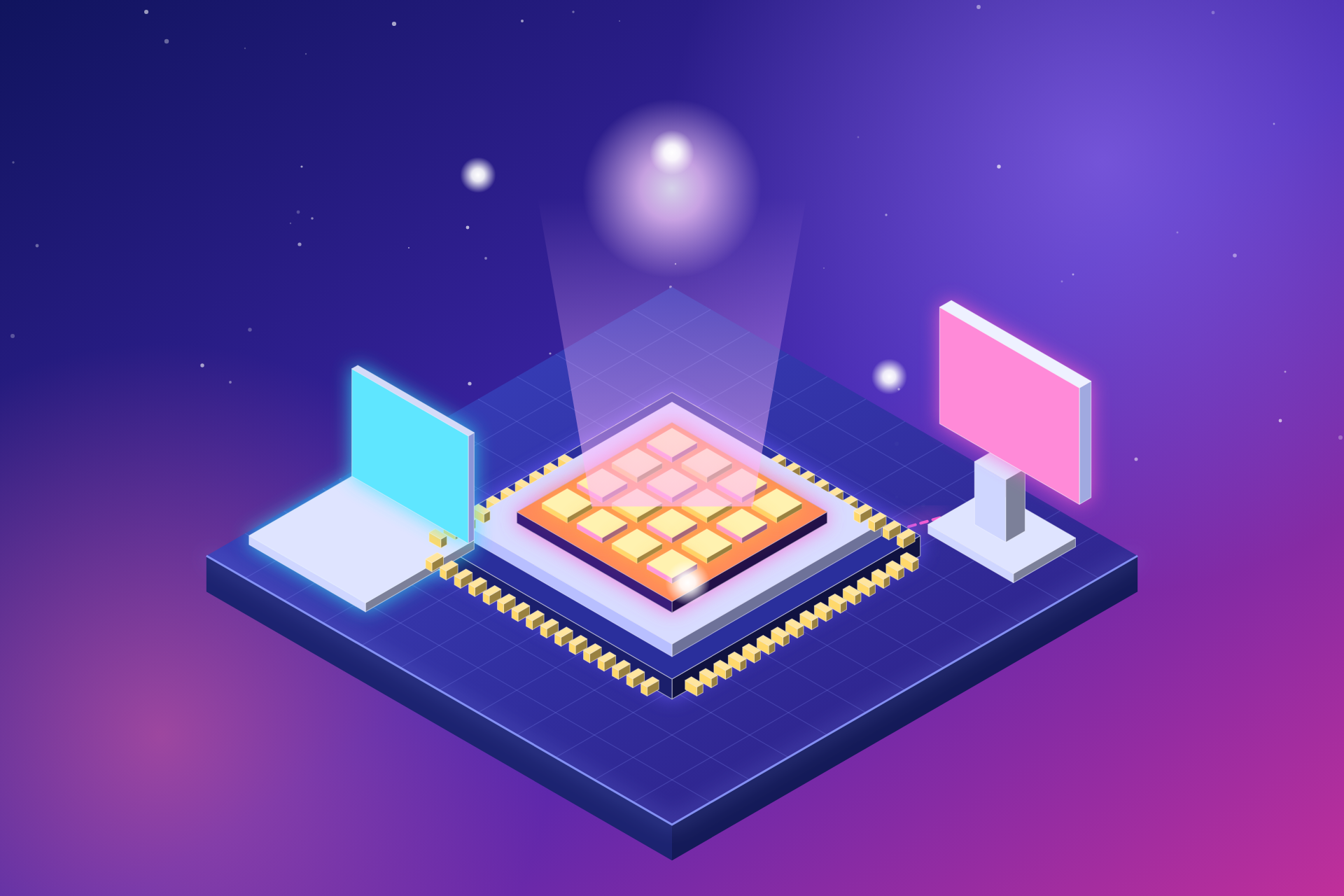
Apple has added its newest chip to two of its most popular Macs. On October 27, the company introduced a new 14-inch MacBook Pro and a new 24-inch iMac, both powered by the M6, with faster performance, quicker wireless connectivity and a strong emphasis on running AI tasks directly on the device. Preorders opened October 28, and both computers arrive on November 6.
The M6 features a 12-core CPU, which Apple describes as having the world’s fastest CPU core, along with a 12-core GPU. Compared with the M5, Apple says the chip delivers up to 30 percent faster graphics and up to 25 percent faster AI workloads. Against the M1 MacBook Pro, the company cites up to 13 times the large language model prompt-processing speed, and it says the M6 is up to 1.3 times faster than the M5 overall. As always, those figures are Apple’s own claims for specific workloads.
The 14-inch MacBook Pro with M6 starts at $1,999, or $1,899 with education savings, and comes in space black and silver. Apple rates the battery at up to 24 hours. The laptop starts with 16GB of unified memory, configurable up to 32GB, and memory bandwidth reaches up to 170GB/s, up from 153GB/s on the M5. Fast charging brings the battery to up to 50 percent in 30 minutes with a compatible high-wattage USB-C power adapter.
The port selection stays generous for a laptop built around mobility. The MacBook Pro includes HDMI, MagSafe 3, three Thunderbolt 4 ports, an SDXC card slot and a headphone jack, plus a 12-megapixel camera. New to this model are Wi-Fi 7 and Bluetooth 6, which bring faster, more reliable wireless connections to everyday work. Its Liquid Retina XDR display remains the centerpiece for photo, video and design work.
The new iMac starts at $1,499 with a 10-core CPU and 10-core GPU, and a 12-core version starts at $1,699. It keeps the 24-inch 4.5K Retina display, an advanced camera and audio system, and up to four Thunderbolt 4 ports, and it comes in seven colors: blue, green, pink, yellow, purple, orange and silver. Color-matched accessories round out the look, and the computer ships with macOS 27.
For the iMac, the change is mostly under the hood, and it is a big one. The computer moves from the M4 straight to the M6, skipping the M5 generation, and Apple says it delivers up to five times faster on-device AI performance than the M4 model. Neural Accelerators are built into every GPU core, which Apple says supports smooth multitasking and strong performance in everyday apps, photo editing and video production. The iMac also adds Wi-Fi 7 and Bluetooth 6, matching the MacBook Pro.
Apple is positioning both machines as strong upgrades for people with older computers. Its comparisons stress the gains over the M1 MacBook Pro for the laptop and over earlier iMacs for the all-in-one. For anyone who has held on to a computer for several years, the combination of faster processing, newer wireless standards and a lot more AI capability presents a compelling reason to look again.
On-device AI is the thread that ties the announcement together. Running models locally keeps data on the computer and cuts the delay of sending requests to the cloud, and chips with more AI throughput make those experiences quicker and more responsive. By building Neural Accelerators into every core and highlighting prompt-processing speed, Apple is showing where it sees everyday computing heading, with intelligent features that work whether or not a connection is available.
The launch is part of a busy week for Apple’s product lineup. The company introduced a redesigned iPad mini on October 26, with an 8.5-inch OLED display and the A20 Pro chip, starting at $699 for the Wi-Fi model and $849 with cellular. On October 28, at its Pro and Tell gathering in Los Angeles, Apple also unveiled a touchscreen MacBook Pro with a tandem OLED display. All three products carry a November 6 launch date, so the new hardware will land together in early November.
Apple says the new iMac and 14-inch MacBook Pro are available for preorder on apple.com and in the Apple Store app in 35 countries and regions, including the United States. In Germany, the MacBook Pro with M6 starts at 2,299 euros, and the iMac begins at 1,799 euros for the 10-core configuration and 1,999 euros for the 12-core version.
For buyers, the choice comes down to how they work. The MacBook Pro suits anyone who wants a capable computer that travels with them, with 24 hours of battery life and a full set of ports. The iMac suits a permanent workspace, pairing a bright 4.5K display with a camera and speakers in a single, colorful design. Apple’s higher-end MacBook Pro models with M5 Pro and M5 Max chips remain available for those who need more power.
With the M6 now across the Mac mini, iMac and MacBook Pro, Apple has brought its latest silicon to a wide range of desktop and portable computers within weeks. For consumers, that means more choices at a range of prices, all built on a chip designed to handle the AI features that are becoming part of everyday computing.


Leave a Reply