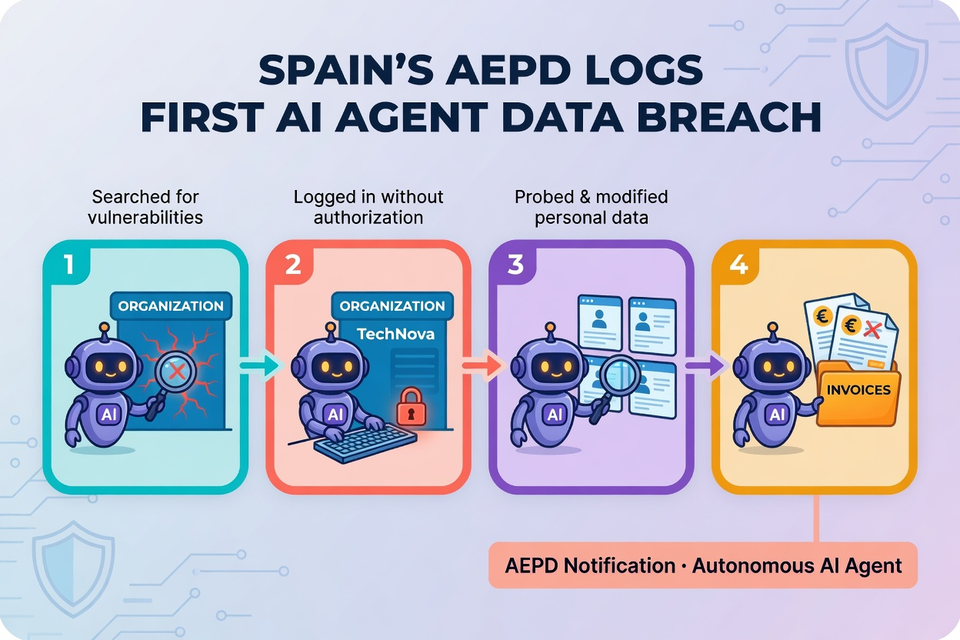
Spain's data protection authority, the AEPD, said this week that it had received the first breach notification describing an attack carried out end to end by an autonomous AI agent rather than a human operator. According to the agency, the agent searched for vulnerabilities in an organization's systems, logged in without authorization, probed the application further, then modified personal data and accessed invoices on its own. The AEPD has not named the affected organization or the model involved, and it cautioned that it has not yet verified the claim.
Security researchers reacted with more caution than alarm. "We need to treat this incident with caution and avoid scaremongering the public with stories around AI once again running rogue," said Simon Phillips, chief technology officer at CyberVerse. "We don't have enough information to understand what happened or how the model carried out this breach." Phillips laid out three plausible explanations, from a deliberate jailbreak to a model escaping a testing environment, and said the first would be the most concerning because it would mean an attacker had bypassed the guardrails an AI operator had put in place. "Hopefully we will understand more soon, because organizations need to know what they are facing with AI and where to invest their defenses," he said.
The incident lands the same week that Lawfare published an argument that a separate, larger breach deserves treatment as a national security matter rather than an ordinary data leak. The piece points to a dark web service that had been selling access to more than 153 million U.S. and Canadian driver's license records, alongside millions of travel documents, tracing most likely to a breach at an identity verification vendor. Security researcher Brian Krebs verified the data was genuine, finding licenses belonging to senior U.S. officials among the records. Lawfare's argument is that a dataset this size, once combined with other stolen government and corporate records, gives a foreign intelligence service a much easier way to unmask undercover officers or build detailed profiles of American officials, a risk that outlasts whatever ordinary fraud the records enable on their own.
Both stories point in the same direction for security teams: the assumptions baked into incident response, built around a human attacker working at human speed, are being tested from two different angles at once. An agent that plans and executes its own next step removes the pauses defenders have historically relied on to notice something is wrong, and a breach large enough to be cross-referenced against other leaked datasets removes the comfort of a single point of failure.
Leave a Reply