
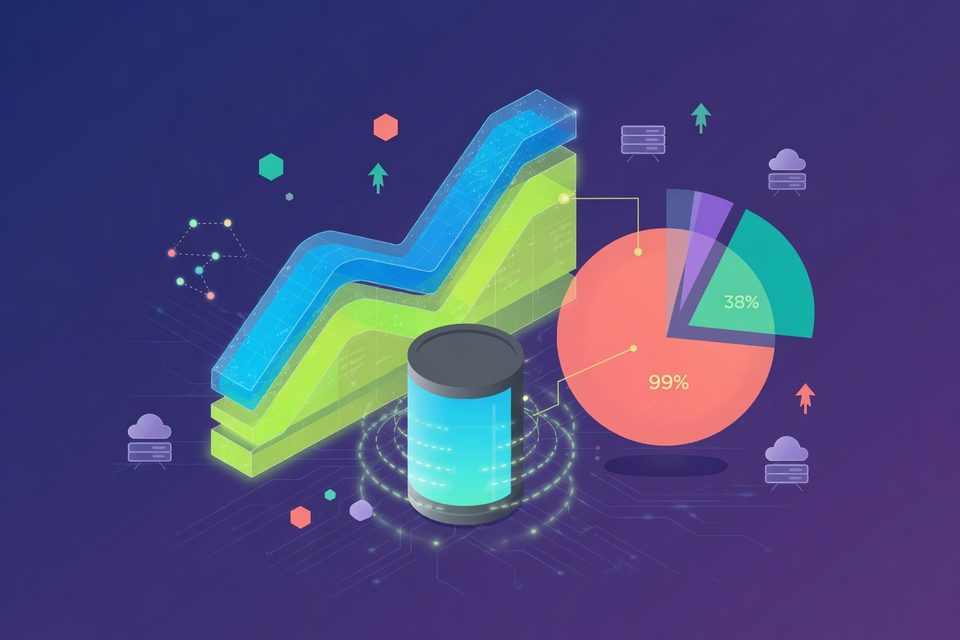
Seagate has published its first Data Infrastructure Readiness Report, a survey of 2,712 enterprise technology decision-makers in seven countries run by Recon Analytics on Seagate's behalf between May and June 2026, and its headline finding is that 99 percent of respondents expect AI to raise their storage requirements within three years while 38 percent call themselves fully prepared.
The provenance matters more than the percentages. Seagate commissioned the work and wrote the framing, and the report's own methodology note says: "The results represent the reported views, expectations and practices of the decision-makers surveyed." That is a poll of what buyers say about themselves, paid for by the company that sells them capacity, and every number below carries that label.
"AI is reshaping the way organizations plan, build and operate infrastructure," said Melyssa Banda, Seagate's senior vice president of Edge Storage Business, in the release. "The next phase of AI will require capacity growth, but capacity alone will not be enough," she added. Translated: capacity is the commodity Seagate sells by the exabyte, and not enough is the pitch for whatever sits above it. The report's name for that layer is sustainable scaling, which it defines as follows: "Sustainable scaling is the ability to increase AI capacity and business value while continuously improving the efficiencies of the infrastructure that supports it." Strip the branding and it is tiering, lifecycle planning and power budgeting.
The numbers with operational content are the constraint rankings. Respondents cite data quality and readiness (53 percent) and storage infrastructure (43 percent) as their leading AI deployment challenges, ahead of compute availability (27 percent) and energy constraints (24 percent). A storage vendor's survey finding that storage outranks GPUs and power as the bottleneck is the report's most convenient result and its least surprising.
Where the survey earns its keep is the sustainability section. Seventy-seven percent say their organization has delayed or restructured an expansion because of energy and sustainability concerns, split between 36 percent who significantly restructured planned investments and 41 percent who took minor delays. Thirty-nine percent rate their storage operations very sustainable today and 61 percent expect to in five years, which is what surveys of intentions always find; the delay figure is the one with teeth for anyone planning capacity. Power consumption is the footprint factor most often weighed, at 62 percent, with device lifespan and durability at 55.
Now the omission. Across the web version of the report the words disk, hard drive, HDD, SSD, flash and tape do not appear once. The nearest it comes is a warning against uniform design: "Rather than applying a single architecture across the entire data lifecycle, organizations can design systems that balance performance, capacity, efficiency and long-term value according to workload requirements." Blocks & Files reads the single architecture as all-flash and the report as a case for buying more disk, and puts the SSD premium at 6.5 times the per-terabyte price of a hard drive, a figure that is Blocks & Files' own rather than the report's. Seagate, which sells the hard drives, left the inference to the reader.
Storage is strategic is the conclusion of every vendor survey in this cycle. The content here is the 77 percent who have already slowed an expansion for power reasons and the 43 percent who put storage ahead of compute as the deployment constraint, and both say the next capacity cycle gets decided in the facilities budget rather than on the drive spec sheet, which is not where a drive vendor's report usually lands.


Leave a Reply