
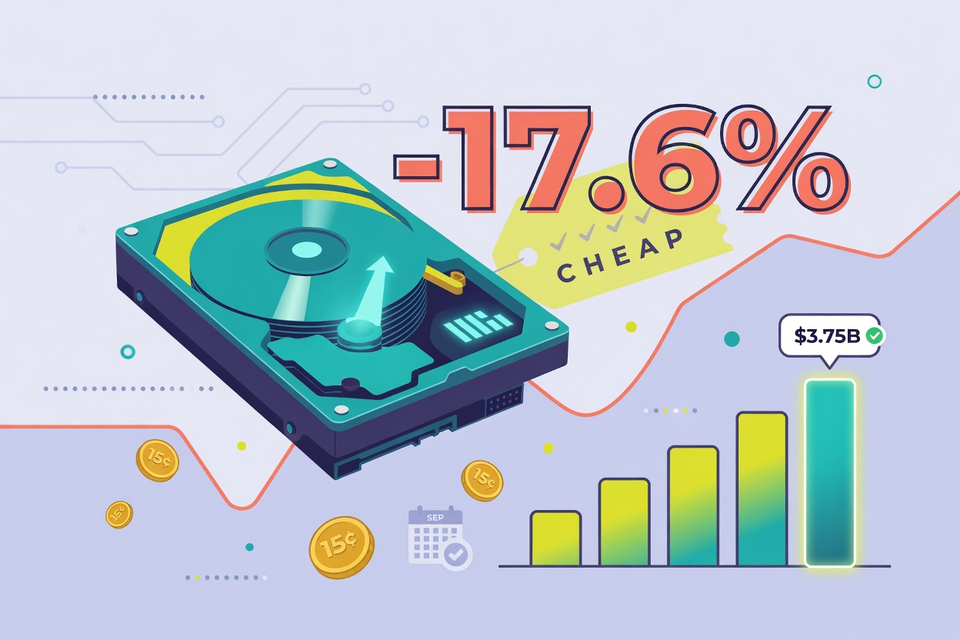
Western Digital is down 17.6 percent from its post-earnings high, and the retreat follows the strongest quarter the company has ever printed. Yahoo Finance's account of the results puts fourth-quarter sales at $3.75 billion with net income of $3.19 billion, alongside a 15 cent per share dividend payable in September.
That second number deserves a second look. Net income at 85 percent of revenue is not a ratio disk drives produce on their own; results in that shape normally involve items below the operating line, and the filing rather than the headline is where the question gets settled. The full year closed at $12.92 billion in sales and $9.42 billion in net income, which frames the same puzzle across four quarters.
"The earnings reaction therefore looks more like an expectations reset than a breakdown in storage demand," concludes TIKR's post-earnings review. Translated, the bar broke before the business did. These shares have traded between $73 and $800 over the past year, and a stock priced for perfection treats merely excellent as a miss. The reporting week cost holders about 20 percent, leaving the price near $434.
Chief executive Irving Tan's line for the quarter was that "Data creation isn't slowing, it's accelerating." Every storage boss says a version of that in every cycle. The substantive part sits in the contract book: coverage of the pullback describes AI customers negotiating storage agreements stretching up to five years, and TIKR points to customer agreements extending into 2031. Multi-year demand visibility is the scarcest commodity in this industry, and Western Digital appears to hold a meaningful amount of it.
Simply Wall St's model still puts fair value at $584.79, roughly 35 percent above the current price. The assumptions doing the lifting are the familiar ones, sustained AI-driven storage demand and margins holding near their current altitude. Set against that, TIKR pegs the gross margin outlook about 200 basis points below Seagate's, and Summit Insights moved its rating from Buy to Hold after the report. An upside case built on peak margins is really a bet that pricing power survives the next round of capacity additions.
Execution is the swing factor. The roadmap calls for 44-terabyte HAMR products in the first half of 2027, with 40-terabyte ePMR drives expected to carry more than half of nearline exabytes by fiscal third quarter 2027. Ship those on schedule into a nearline market that remains tight and the fair-value crowd starts to look conservative. Slip, and the margin gap to Seagate widens from the wrong side.
The bear case needs fewer moving parts: a handful of hyperscale customers write most of the checks, and a single changed cloud roadmap would ripple through every line of the model.
Bootnote: that $73 to $800 range is worth sitting with. A tenfold move in a commodity hardware maker used to take a decade and a merger. This one took four quarters of AI storage repricing, and it explains better than any valuation model how a record quarter can cost a company a fifth of its value in a week.




Leave a Reply