
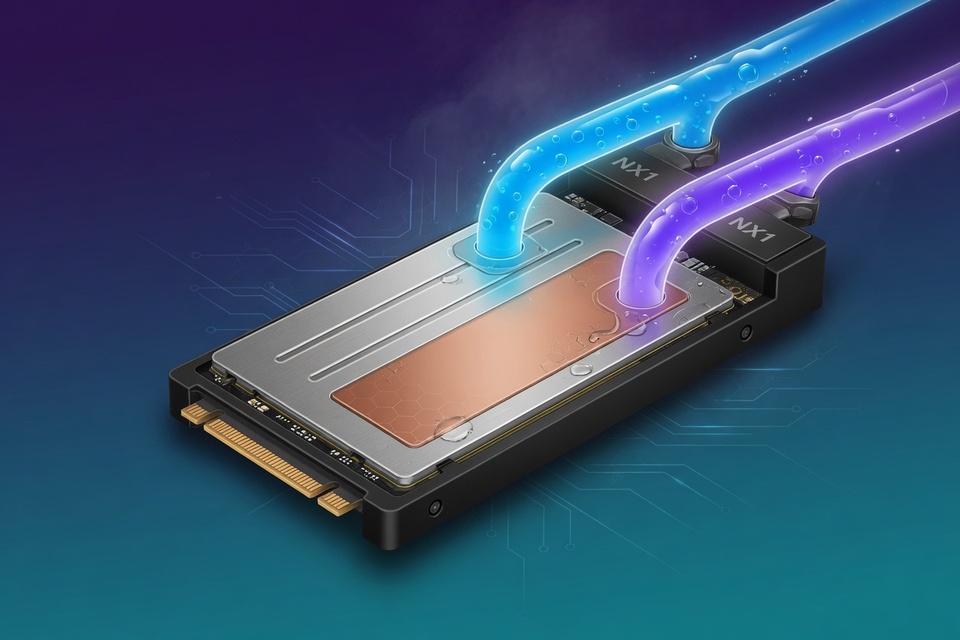
Kioxia is sampling the NX1 Series, its first data center SSD built for direct liquid cooling, an E1.S line for GPU servers that puts a cold plate against the drive itself instead of trusting the airflow.
The line spans 1.92TB to 15.36TB across two E1.S form factors, 9.5mm and 15mm, on PCIe 5.0 and NVMe 2.0, using eighth-generation BiCS flash in TLC trim with the company's CMOS-bonded-to-array construction. Blocks & Files puts the NAND at 218 layers and estimates sequential writes around 8.4GB/s with roughly 300,000 random write IOPS. Only the thinner 9.5mm variant takes the cold plate; the 15mm version stays on air.
Against the XD8 Series it succeeds, Kioxia claims up to 38 percent higher sequential write performance and up to 20 percent higher random writes on the same interface. Neville Ichhaporia, SVP and GM of the SSD business unit at Kioxia America, says: "E1.S form factor SSDs are becoming increasingly important for AI and hyperscale system designs, keeping high-speed flash storage close to the CPU and GPU. With the KIOXIA NX1 Series, we're delivering the performance, thermal flexibility and storage density customers need."
Translated, that means the storage tray was the last air-cooled holdout in racks that already pipe coolant to every GPU, and Kioxia would rather sell into the loop than fight for airflow. Thermal throttling is the quiet killer of NVMe latency in dense trays, so a drive that sheds heat through a plate can hold its rated numbers where an air-cooled part backs off. Those write gains on an unchanged interface read as thermal headroom cashed in rather than a controller breakthrough.
The positioning is unambiguous. Sampling is limited to select hyperscale customers, compliance targets the OCP Datacenter NVMe 2.6 specification, and Flexible Data Placement support is aimed at cloud fleets that already standardize on E1.S trays. Endurance of one drive write per day, per Blocks & Files, marks this as read-intensive AI serving rather than ingest duty. The performance figures remain vendor numbers for now; no independent benchmarks exist while the drives sit in hyperscaler labs.
Bootnote: E1.S descends from the EDSFF "ruler" effort that set out to retire M.2 in servers, and the thickness split has always been a cooling argument, with 15mm buying room for a bigger heatsink. A cold plate on the 9.5mm variant upends that trade, letting the thinner drive out-cool the fat one and putting more slots in the same tray.



Leave a Reply