
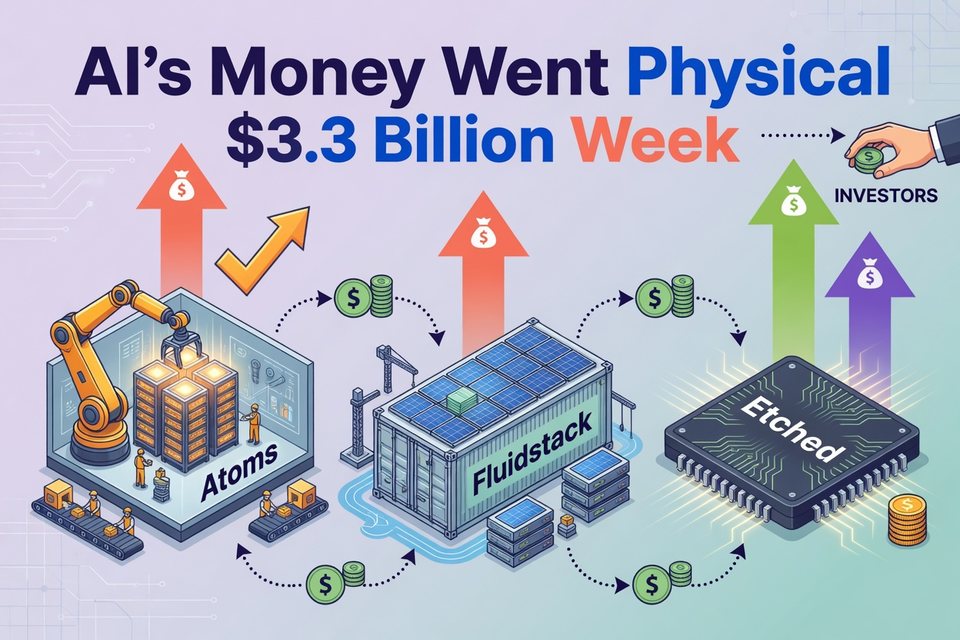
Investors put about $3.3 billion into five artificial intelligence companies in the past week, and the largest checks went to firms that build things: robot-run factories, prefabricated data centers, and inference chips. Software companies still raised, but the physical layer set the pace.
The week's biggest round went to Atoms, the Los Angeles startup founded by Uber founder Travis Kalanick, which raised $1.7 billion in a round led by Andreessen Horowitz to work on what its backers call physical AI, automation aimed at large industrial sectors.
Fluidstack raised $830 million at a $7.5 billion valuation in a Series A led by Situational Awareness, a fund backed by Stripe's founders. The startup is Anthropic's partner on a planned $50 billion of United States AI infrastructure, and it says its factory-made modules cut multi-gigawatt data center construction from years to about six months.
Chipmaker Etched collected $300 million at a $10.3 billion valuation, with Sequoia Capital leading and SK Hynix among the backers. The San Jose company designs inference chips together with the racks, memory systems, and software around them, and now employs about 400 people. "Now is the time to be aggressive. Our chips work, people want them, and it's time to ship," co-founder and chief executive Gavin Uberti said in remarks carried by Pulse 2.0.
Three-dimensional generation drew a record of its own. Meshy AI closed a Series B of nearly $400 million at a $1.5 billion valuation, described in the announcement as the largest funding round to date in AI 3D, with Monolith Capital, IDG Capital, and Matrix Partners China leading.
An unusual unicorn arrived as well. GlossGenius, the salon and wellness software maker founded in 2017 by Danielle and Leah Cohen-Shohet, announced a Series D at a $1.15 billion valuation, rebranded itself Genius AI, and said it now serves more than 125,000 businesses with annual revenue approaching a $200 million run-rate. Lux Capital led the round, which wire coverage puts at $44 million. "We launched GlossGenius in 2017 with a simple idea: use technology to help professionals focus on their service, not their back office," the founders said in the announcement.
Beneath the headline rounds, the week spread money across security and back-office software. Glow, a Palo Alto endpoint security startup, emerged with $100 million of a $180 million total raised, backed by Sequoia Capital, Cyberstarts, Greenoaks, and Redpoint. Neo Security of Boston collected $100 million from Bessemer Venture Partners and Andreessen Horowitz for its agentic software control platform, and Candid Health took in a $120 million Series D led by Sixth Street Growth for revenue cycle management. Battery technology drew capital too: Sila raised $300 million, led by Atreides Management and Sutter Hill Ventures, to expand its silicon anode plant in Moses Lake, Washington.
If the pattern holds, the second half of the year may be defined less by model labs raising megarounds and more by the companies that pour concrete, stack racks, and automate the back office. The capital is already voting that way.




Leave a Reply