
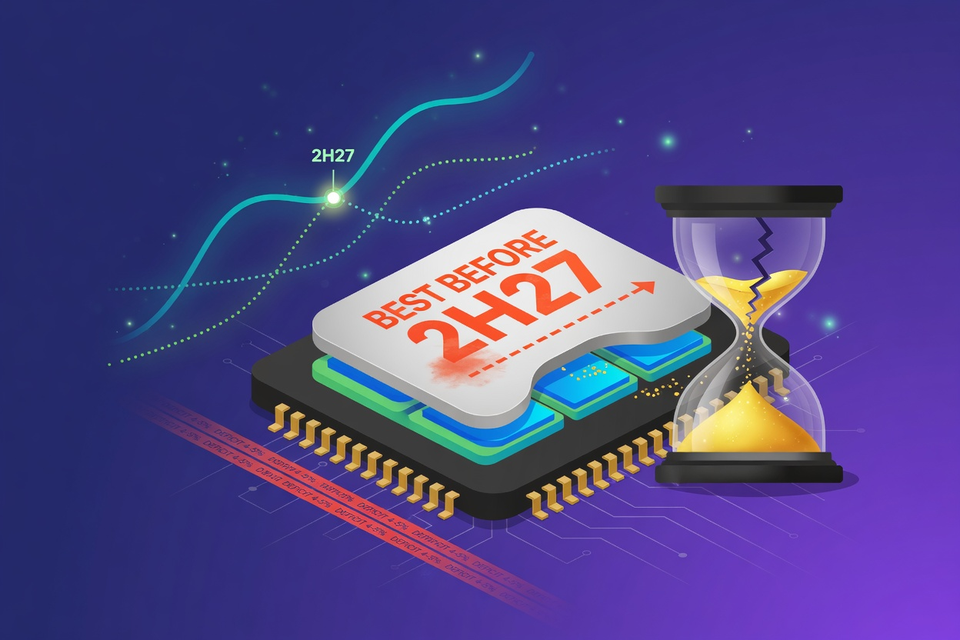
TrendForce has put a date on the end of the NAND flash squeeze: supply growth overtakes demand growth in 2027, and the shortage that has defined this year's storage market starts easing in the second half. The research firm has the market running a 4 to 5 percent supply deficit through 2026, with no relief before then.
The composition of that deficit matters more than its size. Servers now take more than 40 percent of total NAND bit demand, while the segments that used to anchor the market are shrinking outright. TrendForce has smartphone production falling 15 to 20 percent this year and notebook shipments down about 10 percent. Strip out the phones and laptops and this is an AI infrastructure shortage wearing a consumer-market label.
Relief, when it arrives, comes with a flag on it. Chinese suppliers reach nearly 19 percent of global bit output in 2027 by TrendForce's count, which means the marginal bits that tip the market back into balance come disproportionately from fabs the established vendors do not control. The Korean, American and Japanese suppliers are migrating processes rather than pouring new concrete, and the overall balance is expected to turn positive in the second half of 2027.
The tape read the moment differently. SanDisk rose 8 percent to $1,504, Western Digital jumped 9 percent to $531 and Micron added 7 percent to $923 as the memory rebound accelerated, with SanDisk up 533 percent for the year, per 24/7 Wall St. Bank of America's Vivek Arya lifted his Micron target to $1,550 after what he called "another memorable beat," and UBS projects the company could repurchase more than 40 percent of its shares by the end of 2028 on over $400 billion of free cash flow.
Both things can be true, but not indefinitely. The buyback models and the price targets rest on scarcity pricing holding. TrendForce has now published scarcity's expiry date, and if the easing lands on schedule, the argument in memory shifts from how high prices go to how gracefully they come down. That is a different multiple.
Bootnote: The last time NAND supply outran demand, across 2022 and 2023, contract prices fell hard enough that suppliers idled production lines and SK hynix left the Dalian fab it bought from Intel sitting cold. Oversupply in this market has never produced a soft landing, which is why a forecast of easing reads less like relief and more like a warning label.



Leave a Reply