
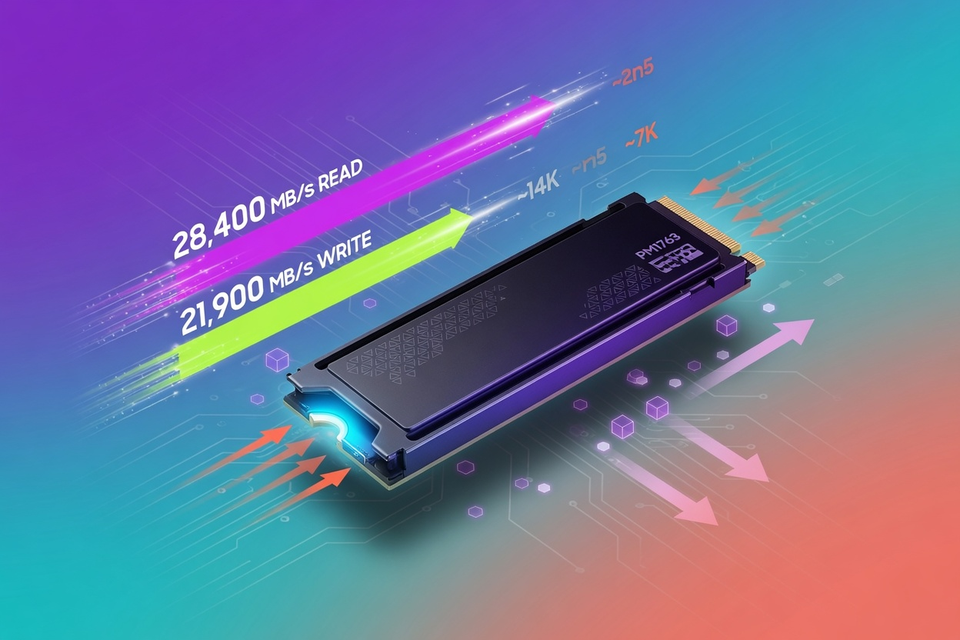
Samsung has put the PM1763 into mass production, a PCIe 6.0 enterprise SSD that reads at 28,400 MB/s and writes at 21,900 MB/s in its 16TB configuration, roughly double the ceiling of the Gen5 interface it replaces.
The drive pairs ninth-generation V-NAND with a new 4-nanometer controller, ships in 4TB, 8TB, and 16TB capacities in the E3.S form factor, and is built for direct-to-chip liquid cooling. Samsung puts the power-efficiency gain at 1.8 times its own PM1753 predecessor, a vendor-against-own-predecessor comparison worth reading as such.
"Built on industry-leading performance, PM1763 has successfully completed validation for next-generation AI platforms and is well positioned to support evolving AI infrastructure requirements. As AI models continue to grow in size and complexity, PM1763 will serve as a key solution that enables customers to efficiently scale memory capacity and optimize AI operations," says Jangseok Choi, vice president and head of memory product planning at Samsung Electronics. Translated, the important clause is the first one: validation is complete before the platforms are. Winning a slot in a reference design ahead of general availability is the actual prize here, because sockets qualified early tend to stay qualified.
That matters because nobody can buy a Gen6 server today. ServeTheHome notes the host silicon arrives with the coming wave of hyperscale CPUs, NVIDIA's Vera, and AMD's EPYC Venice. None of the coverage names a competing Gen6 enterprise drive from Kioxia, Solidigm, Micron, or SK hynix, which makes this less a product race than a claim staked while the track is still being poured.
StorageReview, testing on a Gen6 development platform, measured 6.92 million GPU-issued read IOPS from a single drive and 281 million across a 42-drive chassis, and observes that "for AI shops trying to keep GPU clusters fed without building out a parallel file system across a dozen nodes, the single-server storage argument keeps getting stronger." Decoded: once drives move this much data, the binding constraints shift to CPU lane budgets and network egress, not the media. A petabyte in one box stops being exotic and starts being a procurement question.
Samsung's marquee arithmetic, a 40-gigabyte model loaded in about 1.4 seconds, is the company's own sequential best case. Real checkpoint and load traffic is messier, though even a discounted version of that number changes how long accelerators sit idle.
The security additions travel further than the speeds. Post-quantum cryptography and TDISP support mean the data path between a confidential VM and the drive can be attested end to end, which is the sort of checkbox that decides tenders in regulated estates.
Bootnote: Gen5 enterprise drives spent the last two years pinned near the interface's 14.5 GB/s ceiling rather than any NAND limit. Every PCIe generation doubles lane bandwidth, and the drives reliably show up before the servers do. The PM1753 ran exactly this play in its day, and the qualification slots it won then are the ones the PM1763 inherits now.




Leave a Reply