
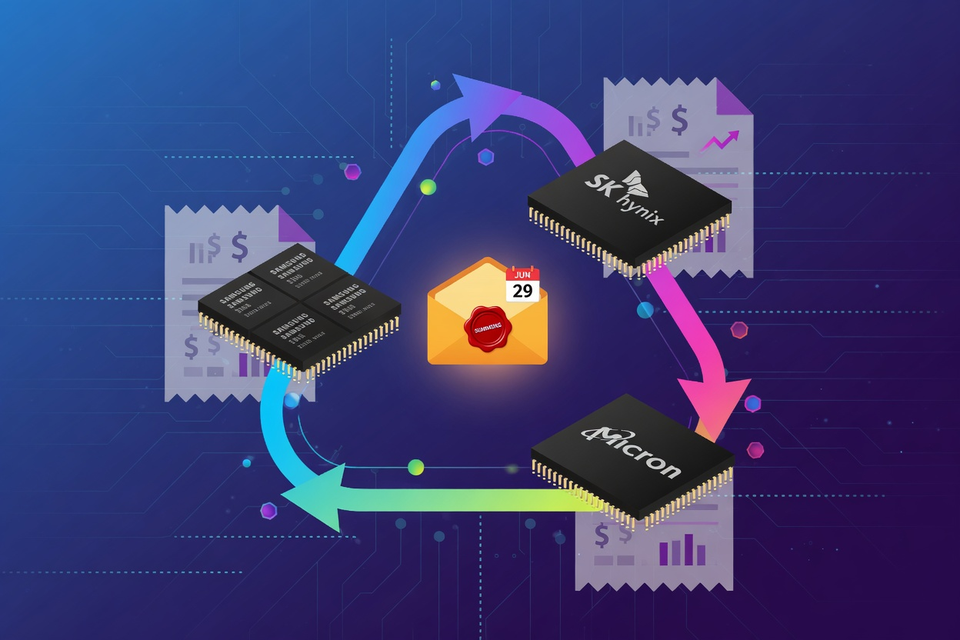
Summonses went out on June 29 to Samsung Electronics, Samsung Semiconductor, SK Hynix, SK Hynix America and Micron Technology, the five entities named as defendants in a conventional DRAM price-fixing class action filed four days earlier in the Northern District of California.
The case is Garciaguirre v. Samsung Electronics Co., Ltd., number 3:26-cv-6345, brought on June 25 by the antitrust firm Bathaee Dunne for 17 named plaintiffs, 14 individual buyers and three small PC building and repair businesses. A reassignment order moved it to District Judge Noel Wise on June 26. No defendant had entered an appearance by the time the summonses issued.
Paragraph one says the suit seeks to recover for and stop "concerted anticompetitive behavior by three oligopolists in the market for dynamic random access memory", and puts their combined share at more than ninety percent of DRAM revenue.
Nothing in it rests on a recovered document or a cooperating witness. The theory is built on the shape of the supply response. Conventional DRAM rose roughly 697 percent on a compounded basis between the third quarter of 2024 and the first quarter of 2026, by the complaint's own arithmetic, and all three producers tightened supply further rather than chasing the price. That, the filing says, ran "contrary to all economic and business logic".
Parallel conduct alone is not a conspiracy, which is why so much of the pleading goes on entry barriers. The complaint puts it flatly: "No new entrant can discipline these three firms in the conventional DRAM market." A single modern fab is priced at fifteen to twenty billion dollars and the EUV tools come from one Dutch supplier already committed years ahead to the incumbents. Even a finished part faces twelve to eighteen months of customer qualification before a large buyer designs it in.
HBM does double duty in the argument. Stacked memory consumes several times the wafer area per bit, so the filing reasons that a modest shift of wafer starts toward HBM withdraws a disproportionate share of commodity supply from the same fabs. The effect is to recast an ordinary product-mix decision as an output restraint, which is what the case turns on.
Micron draws the sharpest allegation. The complaint says the company shut Crucial, its direct-to-consumer DRAM channel, in December 2025, "at the most profitable price point in its history". A supplier abandoning its own retail margin at the peak reads as either coordination or badly timed strategy, and the pleading offers no third reading.
For scale, the filing cites TrendForce projections of $53.7 billion in DRAM sector capital expenditure in 2025 and $61.3 billion in 2026, then argues that almost none of it was aimed at conventional supply. Those are third-party forecasts carried inside an adversarial document rather than audited figures, and they should be read that way.
None of this has been tested. The allegations are unanswered, no defendant has responded on the record, and issuing the summonses only starts the clock.
Bootnote: This is the third such cycle in the same market among the same firms, by the complaint's count. Between 1998 and 2002 Samsung pleaded guilty to criminal DRAM price fixing and paid a $300 million fine, the predecessor of SK Hynix paid $185 million, total penalties topped $730 million, and several executives went to prison. Micron took part and avoided a fine by reporting the conspiracy and cooperating.




Leave a Reply