
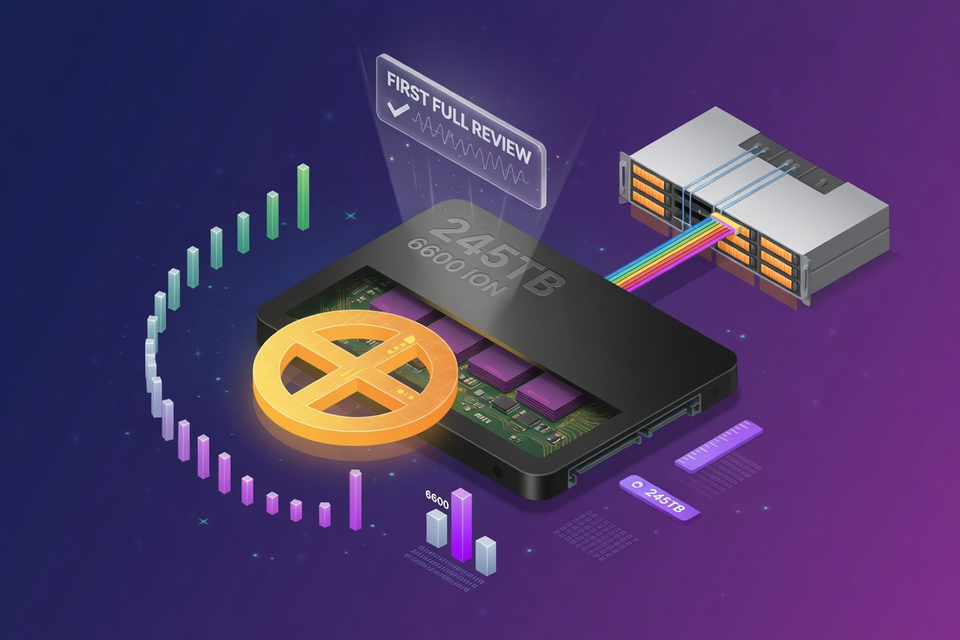
The first full independent review of Micron's 245TB 6600 ION is out, and the occasion matters more than any single benchmark: StorageReview has run the quarter-petabyte drive through its enterprise test bench, which makes this the moment what Micron bills as the industry’s highest-capacity SSD stopped being a spec sheet and became a measured product.
The drive itself is Micron's density play. Built on the company's G9 QLC NAND with a PCIe Gen5 interface, the 6600 ION line runs from 30TB and 60TB through 122TB up to the 245TB flagship, in E3.S, E3.L and U.2 form factors. Micron's product materials put the resulting density at over 4.9PB in a single rack unit using the E3.L 245TB drive, and over 176PB in a full rack, at a maximum rating of 30 watts per drive.
Do the division and the strategic intent is plain. A rack holding 176PB of QLC flash is not competing with performance SSDs, it is competing with nearline hard disk shelves, and the sales pitch is power, floor space and access latency rather than dollars per terabyte, the one metric where disk still wins comfortably.
QLC stores four bits per cell, which is how you reach these capacities, and the trade has always been write performance and endurance. That is why a capacity drive like this gets qualified against read-heavy work: AI data lakes, object stores, content repositories, the tiers where data is written once and read until the cluster is decommissioned. Buyers weighing it should look hardest at sustained write behavior and at rebuild times, because losing a quarter petabyte in one bay concentrates risk that a disk shelf spreads across a dozen spindles.
Micron is not alone in the density race, but a 245TB part in reviewable form puts pressure on every roadmap that promised triple-digit terabytes later. The vendor claims around footprint and energy reduction versus disk come from Micron's own technical brief, with Micron choosing the comparison points, so independent test results are the numbers worth taking into a procurement meeting.
Availability spans the full capacity ladder, and the 245TB part's form factors mean it lands in both new E3 chassis designs and the U.2 bays enterprises already own. That is a quieter but important detail: the largest drive ever sold does not require the newest server to hold it.
Bootnote: the first gigabyte-class 3.5-inch hard drives shipped in the early 1990s, which means capacity per bay has grown roughly a quarter of a million times in one working lifetime. The engineers who managed it never got a parade, but they did make storage cheap enough that everyone stopped remarking on it.




Leave a Reply