
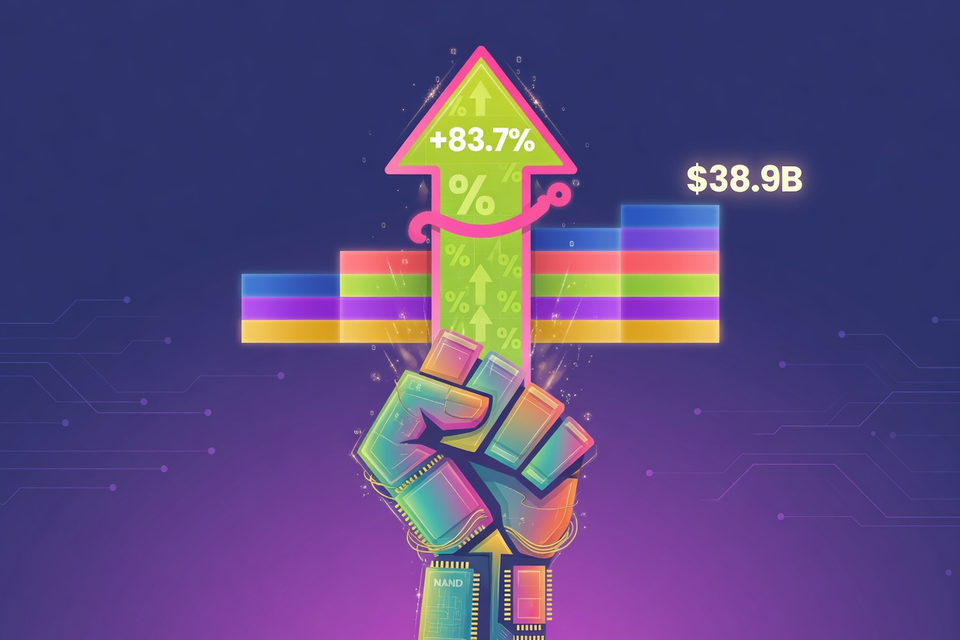
The world's five largest NAND flash suppliers grew combined revenue 83.7 percent quarter on quarter in the first quarter of 2026, to more than $38.9 billion, according to TrendForce.
Samsung took the largest slice. Its NAND revenue reached $13.51 billion on a 104.7 percent quarterly rise, the steepest in the group, lifting revenue share from 28 percent to 31.6 percent.
Second place went to SK hynix Group, which counts Solidigm, on about $7.53 billion and up 44.6 percent for a 17.6 percent share. Solidigm did the heavy lifting, pulling a steady flow of high-capacity QLC enterprise SSD orders.
Third was Kioxia at $5.96 billion, up 80 percent, on 13.9 percent. Micron and SanDisk then tied for fourth, both at $5.95 billion, both up 96.7 percent, both on 13.9 percent.
Read those growth rates against each other and the quarter is about pricing, not shipments. TrendForce puts the jump down to ASPs that broadly exceeded expectations, as cloud providers bought enterprise SSDs for AI server buildouts and a structural shortage of high-capacity HDDs pushed storage orders toward QLC. Revenue that nearly doubles in an industry adding no meaningful capacity is not share won on volume.
On capacity the report is blunt. TrendForce says "major NAND Flash suppliers will add virtually no new production capacity in 2026". That is the sentence worth sitting with, because a shortage running to year end is not a demand forecast that might soften, it is a supply position already fixed by decisions taken several quarters ago.
For the current quarter the report expects the imbalance to hold. It puts the mechanism this way: "Although rising memory costs and higher end-product prices have dampened smartphone and PC demand, brisk server orders will fill this gap". Decoded, consumer demand destruction is real and the suppliers are relaxed about it, because every bit redirected to a server earns more than the handset bit it replaced.
SanDisk deserves separating out. Its data centre business grew more than 200 percent quarter on quarter, which is what a deliberate mix shift toward high-value product looks like when it lands, and it carried the company to the same $5.95 billion Micron reported.
One caution on the share figures. The five named suppliers account for 90.9 percent of the market on TrendForce's own percentages, so roughly nine points sit with everyone else, and any read of Samsung's 31.6 percent needs that denominator kept in view.
Bootnote. The disk angle deserves more attention than it is getting. Nearline HDD supply has been tight long enough that bulk capacity orders are defaulting to QLC enterprise SSD, which means flash is now absorbing demand it was never priced to serve. That substitution, rather than AI training alone, is the quiet reason this shortage is being written up as a full-year condition.



Leave a Reply