
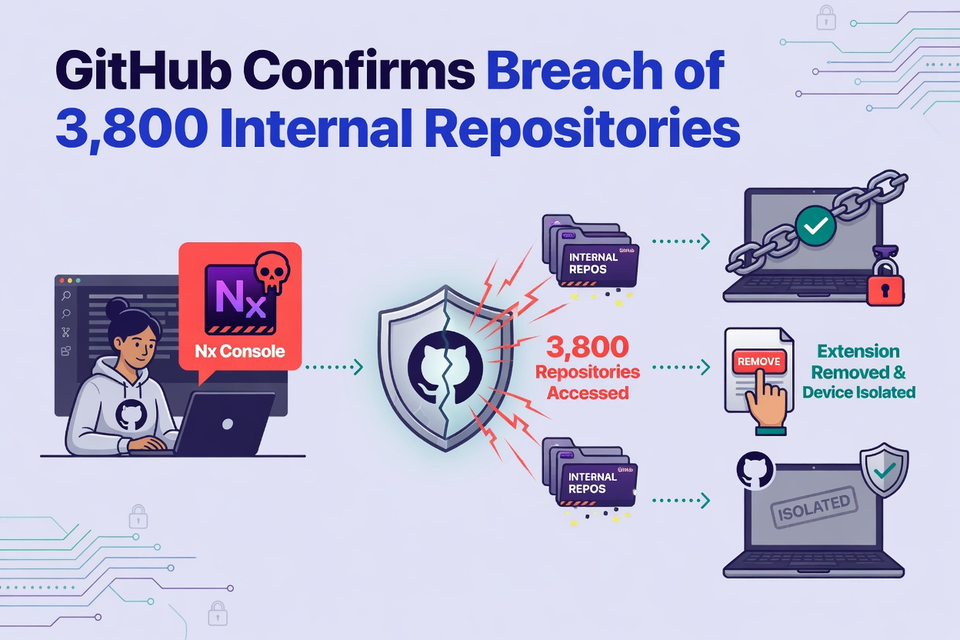
GitHub has confirmed that hackers accessed roughly 3,800 of its internal code repositories after an employee installed a malicious version of the Nx Console extension for Visual Studio Code. The company said it detected and contained the compromise, removed the trojanized extension from the marketplace, isolated the affected device and began incident response.
The company told BleepingComputer it was still investigating the scope of the access and said it has no evidence that customer data stored outside the affected internal repositories was touched. That distinction matters here: the exposure is described as internal source code and related repository data, not the systems GitHub's own enterprise and organization customers store on the platform. On May 21, GitHub linked the intrusion to the same npm supply-chain campaign that had already compromised the TanStack open-source project.
A group calling itself TeamPCP claimed responsibility, posting on a cybercrime forum that it was offering the stolen repositories for sale and seeking a single buyer rather than a broad ransom payment. BleepingComputer reported the group set a minimum price in the tens of thousands of dollars and said it would leak the data for free if no buyer emerged. GitHub has not confirmed the attacker's identity, and none of the group's own claims about what the repositories contain can be independently verified from outside the stolen data.
TeamPCP has previously been linked to supply-chain attacks against GitHub, PyPI, npm and Docker, and more recently to a campaign that also affected employees at OpenAI, according to BleepingComputer. The incident lands amid a broader run of attacks on developer tooling rather than finished software: over the past two years, separate campaigns have compromised the compression utility XZ Utils, the vulnerability scanner Trivy, and more than 500 packages on the npm registry, Cybersecurity Dive reports, and two additional security firms disclosed a separate wave of npm compromises around the same time.
Trojanized extensions have hit the VS Code Marketplace before, and repeatedly. Extensions with a combined 9 million installs were pulled from the store last year over security risks, and ten more, posing as legitimate development tools, infected users with the XMRig cryptominer. A threat actor calling itself WhiteCobra later flooded the marketplace with two dozen crypto-stealing extensions, and in January two extensions marketed as AI coding assistants, with 1.5 million installs between them, exfiltrated data from compromised developer machines to servers based in China.
The platform involved is a large one, separately from this incident: more than 4 million organizations use it, including 90 percent of the Fortune 100, hosting upward of 420 million repositories across roughly 180 million developer accounts. Repository breaches of this kind are hard to size from the outside: GitHub has not said what categories of code or secrets the 3,800 repositories contained, and the company's public response so far has focused on containment rather than on disclosing what, specifically, was inside the exposed repositories.



Leave a Reply