
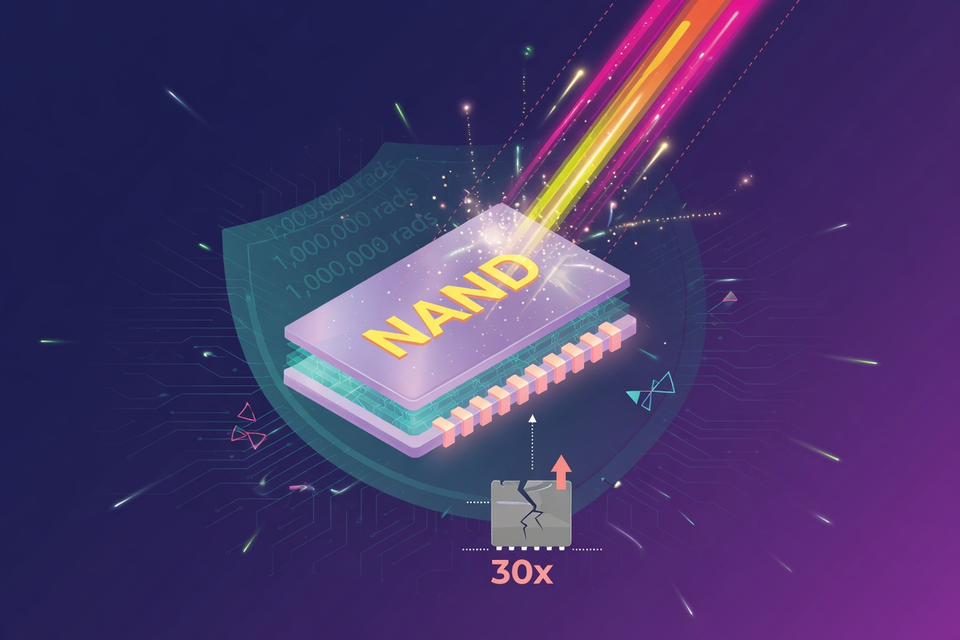
Georgia Tech has built NAND flash memory from ferroelectric material that held data through 1 million rads of radiation, which the university says makes it 30 times more durable than traditional memory.
The change is in where the bit sits. Conventional NAND holds a bit as trapped electric charge, and an energetic particle that disturbs that charge takes the data with it. These devices hold it as polarization in the material instead, in hafnium oxide, which is silicon-compatible and so not an exotic process detour.
"If you send traditional flash memory to space, the radiation interacting with flash memory’s trapped electric charge can easily corrupt the data," said Asif Khan, an associate professor in the School of Electrical and Computer Engineering. Khan continued: "In contrast, ferroelectric NAND flash storage does not store data as trapped electrical charge, but rather stores it as polarization in the material. And polarization is very resilient to radiation effects." Read that as a claim about failure mode rather than about packaging. Nothing here is being shielded harder. The storage mechanism simply has less to lose.
The parts were made and measured by different hands, which matters for a radiation number. Lance Fernandes, an ECE doctoral student and the paper's first author, built the chips in Georgia Tech's cleanroom and sent them to collaborators at Pennsylvania State University for radiation testing.
Penn State's testing put the tolerance at 1 million rads, which Georgia Tech translates as the equivalent of 100 million X-rays. The university's own mission thresholds are the context that makes the figure readable: 5 to 30 kilorads for low-Earth orbit satellites, 100 to 300 kilorads for geostationary orbits, and deep space missions topping out at 1 million rads. Against the first two the headroom is enormous. Against deep space the measured tolerance lands on the ceiling rather than above it, and the margin at that end is the number the announcement does not give.
"For data storage in space, it’s not enough for memory to work. It has to remain reliable under extreme radiation," said Fernandes. The commercial reading is that this aims at the job NAND already does rather than at a narrow radiation-hardened niche. Georgia Tech frames spacecraft as increasingly having to process and store their own data, with artificial intelligence potentially the primary tool for handling the volume, and NAND as the terabit-class technology already doing that work in laptops, smartphones and data centers.
Anyone sizing this for a real spacecraft should note what a university research announcement is not. No endurance, retention, program and erase cycling or per-die capacity figure appears in it. Those belong to the paper, which Georgia Tech lists as Nano Letters 2026, volume 26, issue 10, pages 3390 to 3397, under the title Enabling Radiation Hardness in Solid-State NAND Storage Utilizing a Laminated Ferroelectric Stack.
Bootnote: ferroelectricity in hafnium oxide, the property this entire result rests on, was discovered only about 15 years ago, and Khan's lab has spent the past decade working out what it can do. The work was supported in part by SUPREME, one of seven centers in JUMP 2.0, a Semiconductor Research Corporation program sponsored by DARPA, and was performed as part of the Interaction of Ionizing Radiation With Matter University Research Alliance.



Leave a Reply