
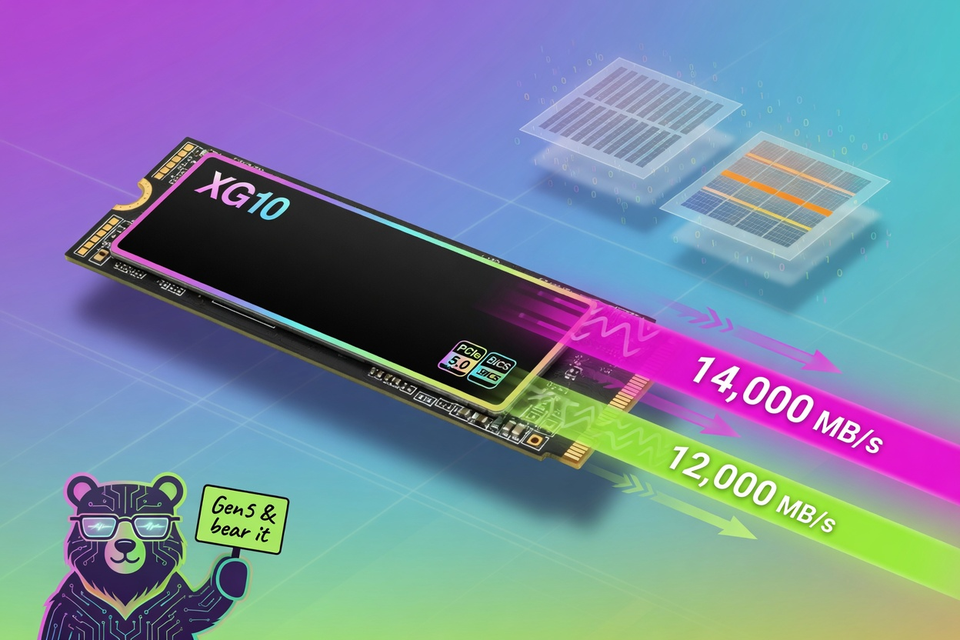
Kioxia has announced the XG10 Series, a PCIe 5.0 client SSD for PC OEMs that the company rates at up to 14,000 MB/s sequential read and up to 12,000 MB/s sequential write.
Random performance is where the generational claim actually lands. Against the XG8 Series it succeeds, Kioxia puts the XG10 at roughly 122 percent higher random read and roughly 158 percent higher random write, with sequential read up to 2x and sequential write more than 2x. In absolute terms that is up to 2,000 KIOPS read and up to 1,600 KIOPS write.
The rest of the sheet is conventional for a Gen5 client part. M.2 Type 2280, NVMe 2.0d, a Gen5 x4 link, and self-encrypting drive support built on TCG Opal 2.02. Capacities run 512 GB, 1,024 GB, 2,048 GB and 4,096 GB.
"AI, content creation and high-end gaming workloads are driving the need for higher client storage performance," says Jürgen Ahaus, general manager for SSD marketing and engineering at Kioxia Europe. Read that as a positioning statement rather than a demand signal. The XG10 is an OEM part, so the workloads that matter commercially are the ones a notebook or workstation builder writes into a spec, and the AI PC label is currently what unlocks a higher bill of materials.
Ahaus is more specific on what changed under the hood: "As the successor to our KIOXIA XG8 Series, the KIOXIA XG10 Series leverages PCIe 5.0 to deliver a leap in performance and responsiveness, enabling PC OEMs to design next-generation systems for today’s most data-intensive applications." The interface is doing most of that work. Doubling sequential throughput is what Gen5 buys at the link layer; the random numbers are the ones that required controller and firmware effort, and they are the ones a system builder should be benchmarking.
The detail worth stopping on sits in the footnotes. The 512 GB and 1,024 GB models use BiCS FLASH generation 6 TLC. The 2,048 GB and 4,096 GB models use BiCS FLASH generation 8. That is two different NAND nodes inside one product family, and it means the small-capacity XG10 is not a smaller version of the large-capacity XG10. Die count, endurance behaviour and sustained write performance after cache exhaustion will differ across the range in ways the single headline figure hides.
There is a plainer reading available. The rated speeds are family headline figures, and the capacities carrying the newer flash are also the ones with enough die in parallel to reach them. Kioxia does not address the split, and the release offers no per-capacity table.
The XG10 is sampling to selected PC OEM customers now, with systems carrying it expected from the second quarter of 2026 onwards. No endurance rating accompanies it, which is the house pattern rather than an omission peculiar to this launch; the EG7 and BG8 releases from the same newsroom carry none either. Power is the more interesting silence. Both of those releases at least name power consumption as a design goal, and the XG10 release does not mention power at all, which for a 14,000 MB/s M.2 2280 part is the first number a system builder will ask for.
Bootnote. Every performance gain in this announcement is expressed as a multiple or a percentage against the XG8 Series, and Kioxia publishes no XG8 absolute figures alongside them, so the 122 and 158 percent random numbers cannot be reduced to XG8 baselines from this document. The one hard caveat the release does supply is regional: availability of the self-encrypting drive lineup may vary by market.




Leave a Reply